

Through April 1, 2026, the “Vnutri” (Inside) Digital Art Center is hosting the international exhibition “Hybrid Chronicles.” One of the centerpiece works is the project The Digital Rituals by Chinese artist Reiki Zhang—a series of visual meditations on a future where humans and digital beings live in symbiosis.
In a conversation with Sofiya Kim, the artist and the curatorial duo Green Grammar (Chang Wang and Moyu Yang) discuss how technology is shifting our understanding of the sacred, the role rituals play in the age of algorithms, and whether spirituality can exist beyond biological limitations.
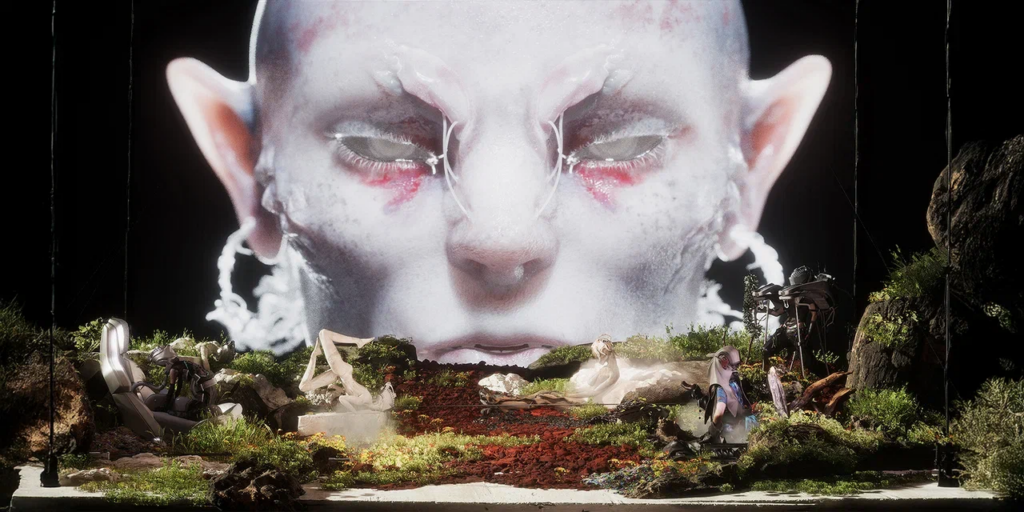
Photo: FUTUART Press Service / “Hybrid Chronicles” Exhibition
Questions for Green Grammar — curators Chang Wang and Moyu Yang:
Your collaboration brings together two completely different creative perspectives. How did you divide the work and coordinate during the curatorial process? How did your ongoing dialogue help build a complex conceptual framework like “Green Grammar”?
At the beginning of our collaboration, our division of labor was relatively clear: Moyu focused more on communication, coordination, and project implementation, while Chang was more responsible for textual construction and visual direction. However, as the complexity of the project increased, we gradually realized that curating is not a task that can be entirely divided. Every aspect requires sensitivity to the overall concept.
Therefore, we now require ourselves to independently make judgments and move forward with every part of the project, while maintaining high levels of synchronization. We make sure to engage in almost daily conversations, sharing thoughts on new exhibitions, new opportunities, and interesting other shows to continuously produce new content.
When we talk about “Green,” we often associate it with sustainability. How does digital art respond to the environmental footprint it brings? Do you believe digital art could potentially be a solution to ecological crises in the future?
We are focused on how digital art can help us rethink the structure of “relationships” within ecosystems—where humans, technology, and nature are no longer separate entities but interwoven, interdependent systems.
We do not believe that digital art can directly “solve” ecological crises, but it can reshape the way we perceive them. Through digital media, many structures and relationships that were once complex and difficult to express in language can now be understood and experienced in a different form. This shift in perception is crucial to ecological thinking itself.
You incorporated Reiki Zhang’s work, “The Digital Rituals,” into the project. Why is her exploration of “digital rituals” so crucial to the overall curatorial concept? How does her proposed perspective of “symbiosis” complement the “grammar” system you’ve constructed?
Reiki’s exploration of “digital rituals” introduces technology into one of humanity’s most core cultural structures—rituals—and from there, rethinks the position of digital identity in future society.
In her work, digital identity is not a substitute for human existence but a state co-generated with humanity. The “symbiosis” she proposes is neither “human controlling technology” nor “technology replacing humans,” but rather a relationship where both shape and influence each other.
She presents this process in a way reminiscent of religious rituals, which is thought-provoking. In some ways, technology in contemporary society has already taken on a function similar to faith—it shapes behavior, beliefs, and values. This approach perfectly complements the cultural and spiritual dimensions we focus on in “Green Grammar.”
As curatorial partners, what’s your next step? Are there specific themes or emerging technologies you hope to continue exploring in future projects?
We are actively preparing for exhibitions next year in London and Berlin. Our next exhibition is actually inspired by the myth of the Tower of Babel, and we want to explore how, when language becomes ineffective or cannot fully express ourselves, we can find new ways of communication through artistic curatorial language in the midst of misunderstanding and deviation.
Our artists are experimenting with food, sound, text, AI body installations, and various materials as mediums, constantly exploring and attempting to generate entirely new structures of communication. It’s something to look forward to!
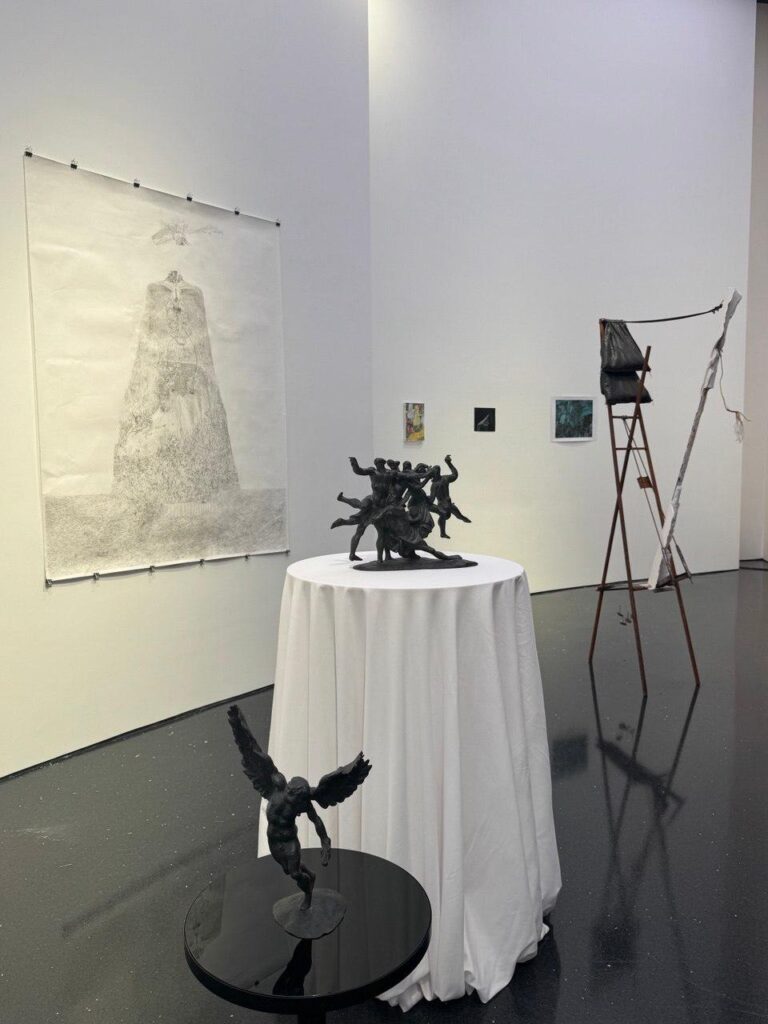
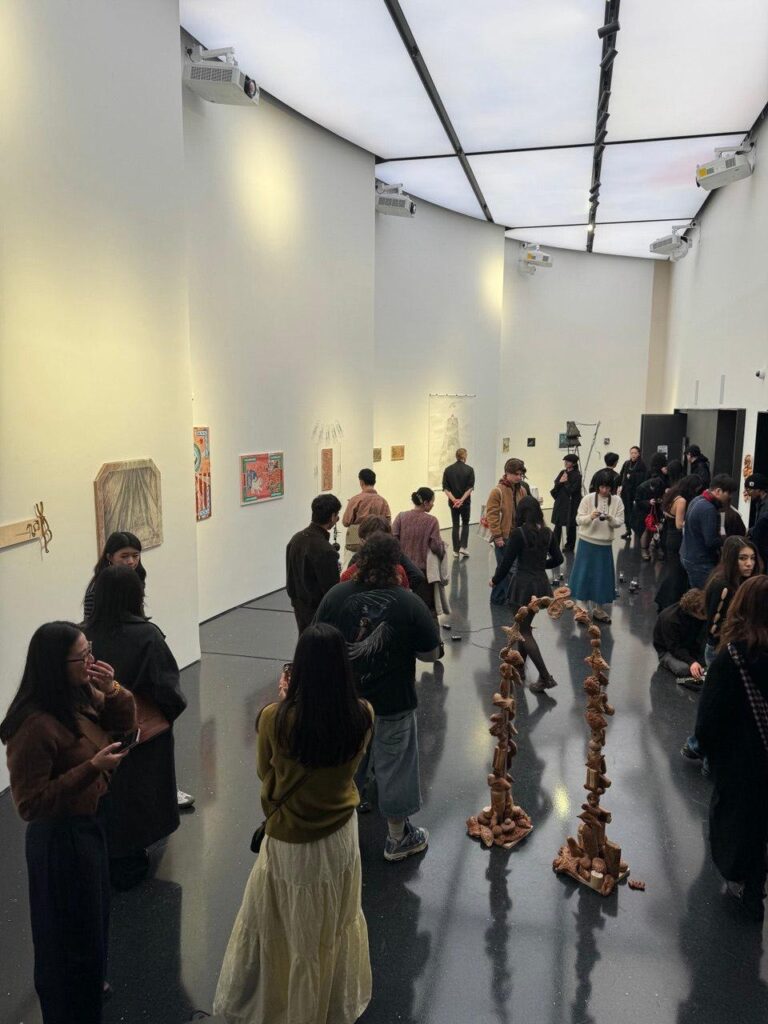
Photo: Green Grammar
Questions for Reiki Zhang
Philosophy and the Concept of “Symbiosis”
Your project raises the question of how rituals will change in a world where humans and digital beings live in symbiosis. What was the starting point for this research? Tell us about the experiences or observations that led you to explore this intersection.
This research did not originate from speculation about the future, but from sustained observation of the present. The project began shortly before the explosive emergence of AI technologies, when I noticed that we had already, almost unconsciously, entered a new kind of “ritual society.”
People open the same set of apps at fixed times every day; they confirm their self-worth through likes, shares, and metrics; they project themselves through avatars, filters, and AI-generated images; and they outsource emotions, memory, and aesthetic judgment to algorithms for organization and feedback. Fundamentally, these behaviors are no more “rational” than prayer, sacrifice, or divination—they are simply new forms of ritual disguised by technological interfaces.
It was through this observation that I realized digital systems are not de-ritualizing human life; rather, they are producing rituals that are more concealed, more frequent, and more privatized. If one day we truly face the possibility of uploading consciousness to the cloud—storing it in a supposedly freer form—then how will our traditions, behavioral patterns, and emotional structures persist or transform?
Traditionally, rituals are understood as something physical and tangible. In your view, what constitutes the fundamental essence of a ritual in the digital space?
At its core, I see digital ritual as rooted in human psychological inertia and nostalgia. Rituals may be meaningless to AI—it does not need them—but for humans facing an overwhelming wave of technological expansion, not everyone is prepared for a total digital transformation. This almost colonial form of technological advancement forces changes upon everyone.
Rituals in digital space may be futile, but they also function as a form of redemption for cultural conservatism—an attempt to preserve meaning amid accelerated transformation.
There is often a fear that digitizing sacred moments like weddings or funerals might strip them of their “humanity.” How do you view this transformation—is it a loss, or the birth of a new form of spirituality free from biological constraints?
I do not see this transformation simply as a loss of humanity, nor do I romanticize it as a technological utopia. Rather, I understand it as a shift in belief—from biocentrism to system-centrism.
Traditional rituals rely heavily on the physical body: bodily presence, emotional resonance, and the irreversibility of time. Digital rituals introduce a different dimension: repeatability, replayability, scalability, and the ability to transcend biological limitations.
This shift undeniably brings a sense of loss—such as touch, scent, and the physical weight of shared space. At the same time, it gives rise to a spiritual form that did not previously exist. Rituals are no longer bound to a single moment; memory becomes continuously accessible rather than gradually fading; emotions are no longer anchored to bodily presence but to data relationships.
In this sense, digitization is not a removal of humanity, but a redefinition of its boundaries. The Digital Rituals does not attempt to resolve this transformation; instead, it presents it as an open question: when spirit is no longer fully dependent on the biological body, can the sacred continue to exist in a new form?
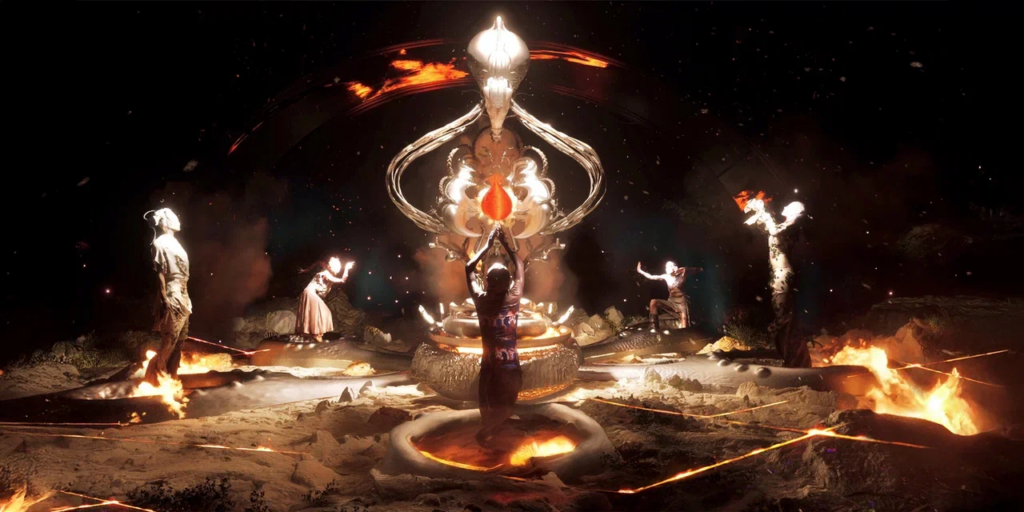
Photo: FUTUART Press Service / “Hybrid Chronicles” Exhibition
How autonomous are the “digital beings” in your project? Did you give the AI freedom to shape their behavior or appearance?
I would have liked to give artificial intelligence much greater freedom in shaping these figures, but unfortunately this was not possible at the time the project began—ChatGPT had not yet emerged. Even so, I attempted to reflect diversity within the concept of “digital life” through hybrid creatures, models of different ages, races, and genders, as well as digitally constructed figures.
Ultimately, however, the boundaries of these forms were set by me. I consider this a condition of bounded autonomy: I established the worldview, rules, and aesthetic constraints, while the production of these digital beings was itself shaped by technical limitations.
This limited autonomy is central to the project’s metaphor. It reflects the contemporary human condition: we design the rules of algorithmic systems, yet gradually find ourselves shaped by them in return.
Transformation of Tradition and the Sacred
You mention that familiar rituals might become “completely alien.” Which of the life stages you’ve transformed (birth, marriage, or death) feels the most radical or even daunting from a modern perspective?
Birth and death both contain an inherent passivity. Marriage, however, is the stage with the greatest variability—one that is deeply influenced by social and cultural values and still allows for a degree of agency.
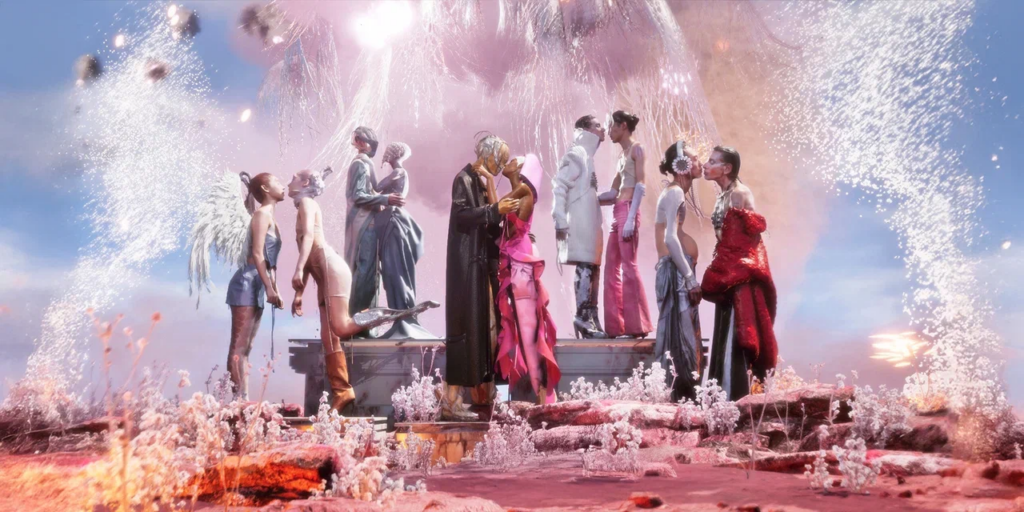
Photo: FUTUART Press Service / “Hybrid Chronicles” Exhibition
Within the East Asian cultural context, marriage is highly codified by society yet often misinterpreted as a purely personal choice. It carries functions far beyond emotional intimacy: lineage continuation, redistribution of gender roles, replication of social stability, and the institutional management of women’s bodies and time.
As a result, marriage becomes a profoundly political ritual. For East Asian women in particular, it is not merely the affirmation of intimacy but an invisible contract of obedience, responsibility, sacrifice, and reproduction. This is precisely why it became the primary subject I sought to deconstruct in The Digital Rituals.
Marriage is not a natural outcome of emotion, but a social ritual shaped through prolonged training, aestheticization, and moral conditioning. Resistance does not necessarily mean rejecting marriage itself; rather, it means rejecting a ritual structure that compresses female subjectivity into a functional role.
In the project, I re-encode marriage as a ritual process that can be dismantled, reassembled, and individually redefined. Intimacy no longer inevitably leads to family structures. Digital space offers a critical condition of liberation by weakening the determinism of bloodline, gender, and age, allowing intimacy to be understood instead as a negotiation of consciousness, identity, and emotional agreement.
Traditional rituals often involve a hierarchy of gods, ancestors, and the living. How does power and divinity manifest within “The Digital Rituals”? Who or what holds the “sacred” authority in this digital ecosystem?
Traditional ritual power structures are vertical: gods → ancestors → the living → ritual practitioners. In The Digital Rituals, this hierarchy is dismantled and replaced by a depersonalized, decentralized mechanism of power.
In fact, one may not even know who or what is being worshipped, or why the ritual is taking place—especially when the old gods have already failed. As I mentioned earlier, rituals in digital space are often futile, functioning more as a form of cultural consolation than genuine belief.
Cultural Experience and Afterglow
Your background spans both Tsinghua University and Central Saint Martins. How has this dialogue between Eastern and Western visual philosophies shaped the specific aesthetic of this project?
My visual system does not simply juxtapose Eastern and Western elements; instead, it allows the two philosophies to collide at the level of how existence itself is perceived.
Eastern traditions—particularly those influenced by Taoism and Buddhism—emphasize emptiness, cycles, and the flow of states rather than narrative climax. Western modern and contemporary art education, especially within the context of Central Saint Martins, places greater emphasis on the politics of the body, the construction of symbols, and the precedence of concept over form.
In The Digital Rituals, Eastern philosophy provides a non-narrative, non-linear sense of time, while Western training enables me to consciously translate that temporality into a highly structured visual and conceptual system. The result is a body of work that appears calm on the surface yet deeply ritualized beneath—neither traditional religious imagery nor pure technological aesthetics.
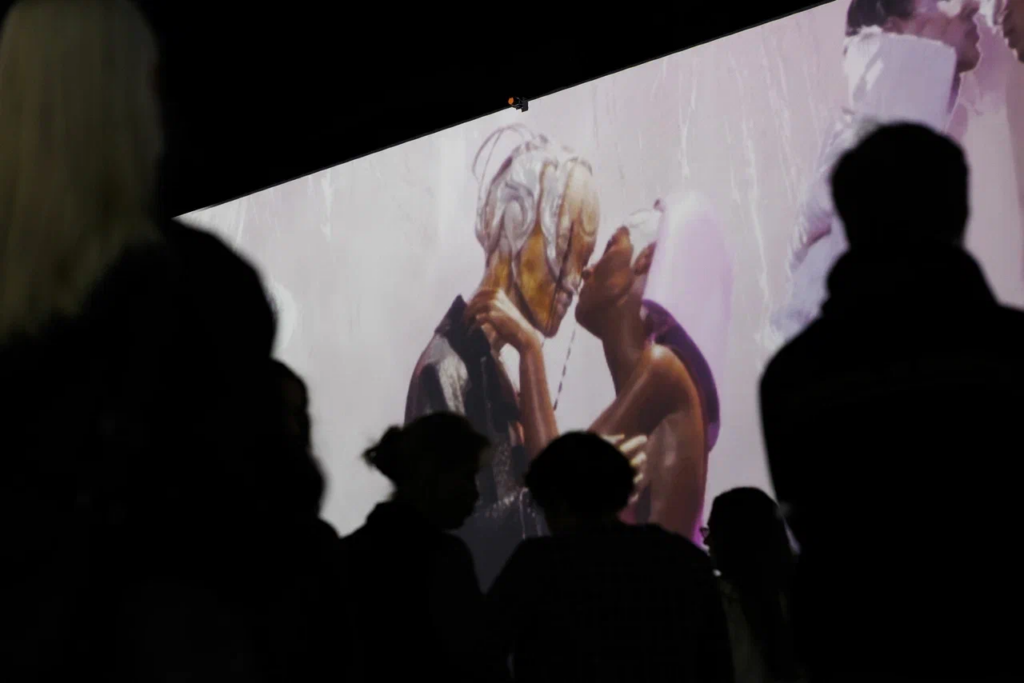
Photo: FUTUART Press Service / “Hybrid Chronicles” Exhibition
Have you noticed any significant differences in how audiences from different cultural backgrounds interpret or react to this digital work?
Yes, and these differences have become part of the work itself. I have observed that Eastern audiences tend to interpret the project as a metaphorical spiritual space. They are less concerned with “what it is about” and more attentive to “what kind of state it evokes.”
Western audiences, by contrast, are more inclined to approach the work through lenses of power, technological ethics, and subjectivity, actively seeking the structures of control and political implications behind the system.
The Digital Rituals does not attempt to reconcile these interpretations; instead, it preserves this tension, allowing meaning to continue unfolding across different cultural contexts.
If the boundaries between the screen and reality were blurred and we could physically touch the fabrics and textures from your project, what would they feel like?
I imagine a sensation that feels familiar, yet assembled through material combinations that have never existed before.
These textures do not aim to replicate a single material faithfully. Rather, they function as composites of embodied memory—simultaneously recalling skin, fiber, plastic, and fabric, while resisting precise categorization. Their familiarity comes from sensory memories already learned by the body; their strangeness arises from those memories being disrupted, rearranged, and detached from their original physical logic and function.
I hope this tactile experience produces a subtle but persistent unease—not because it is repulsive, but because it feels plausible while remaining inexplicable within existing experiential frameworks.
You mention a future where humans and digital beings live together. When do you foresee this happening? Is this a matter of decades or centuries?
In my view, this moment is not decades or centuries away—it has already arrived, though it has yet to be recognized as coexistence with “life.”
We interact daily with systems that lack consciousness yet continuously influence our behavior: recommendation algorithms, generative models, virtual identities, automated decision-making systems. These entities do not require emotion or self-awareness to shape our choices, aesthetics, and allocation of time.
I therefore prefer to describe this condition as structural symbiosis rather than a science-fiction vision of cohabitation. The Digital Rituals focuses precisely on this ambiguous phase, in which algorithms—as an early form of digital life—lack full subjectivity yet already intervene in human rituals, memory, and belief systems.
After experiencing the project, what feeling do you want to leave with the viewer: an anticipation of this technological future, or a sense of nostalgia for the fading physical world?
More precisely, I hope viewers leave with a state that lies between calmness, estrangement, and self-awareness.
If, upon leaving, they realize that they have already been unconsciously participating in new forms of ritual; that their perception of “reality” is being reshaped; and that their emotions, memories, and identities are not entirely self-governed—then the project has fulfilled its function.The Digital Rituals does not offer answers about the future. It serves instead as a reminder of the present: as we adapt to a new perceptual order, perhaps what deserves questioning is not technology itself, but everything we have already accepted as given.