

Gordon Massman talks about painting as if it were a contact sport: attack the canvas, distrust rules, let the body lead. Yet his work is crowded with literature and the residue of a life spent writing and teaching. ST.ART spoke with Massman about what happens when instinct collides with an archive, and why, for him, a painting can never really fail.
In The Essential Numbers 1991–2008, you replaced conventional titles with numbers. What did numbering allow you to do that language could not, and does any part of that logic survive in your paintings?
Bear with me:
In 2013, The New York Quarterly Press published the 400-page complete numbers project titled 0.174: The Complete Numbers which took me 20 years to write. This title refers to The Visible Human Project of 1994–95 coordinated by the US National Library of Medicine in which male and female cadavers were minutely sliced laser-thin and cross-sectionally photographed between slices, thereby painstakingly mapping the human body.
The distance between slices was 0.174 mm. Metaphorically, I performed on my psyche what the Visible Human Project performed on human materiality. Each poem in the series presents a verbal “photograph” of my deepest subconscious urges, fantasies, motives, terrors, insecurities, and cruelties written graphically and with brutal, even self-incriminating, honesty. Rather than title each piece in this extensive related series of images, I numbered them in the order written. Originally, we had 3000 poems from which we selected the best. I consider this collection one single poem with numerous interrelated and coordinated parts.
You spent years teaching literature, yet often describe professors, critics and rules as obstacles to art. What did teaching reveal to you about authority, and what did you later have to unlearn?
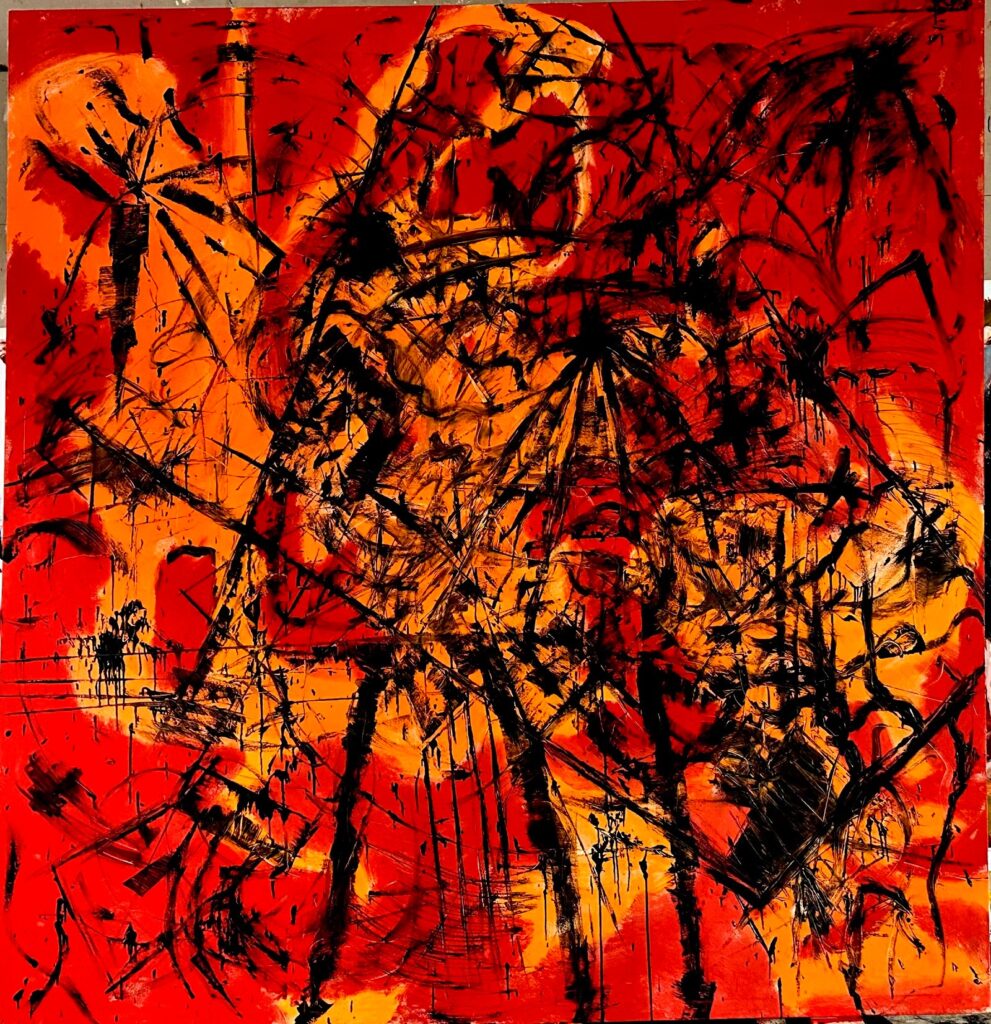
I paint best when I bury my cerebral function with sheer animality. Rather than allow muscle memory of schooling, meticulous skills, and rules to inhibit my movements, I unleash the brute of me. This creature unlocks the primitive raw visceral impulse to create a painting. I have zero interest in artistic tradition, mimicry, or membership. I am untamed and without sophistication. I allow myself to attack, slash, splat, claw, gouge, smear, and devour the prey of my painting.
My studio is a killing floor, and I emerge from it each day coated in the entrails of thick oil paint. It took a cataclysmic emotional event for me to reject the self-perpetuating so-called art establishment, be it of poetry or painting. For me, serious work incontrovertibly requires a raging disposition. I do not paint in repose; I paint with a thick ineducable instinct.
Yes, this is hyperbolic. The brain controls everything and the body is but the brain’s vehicle, its multipurpose utility knife, while the heart is but another functional organ like the pancreas or liver. Yes, this is fact. But I do my best while painting to vanquish this imprisoning judgmental dictator.
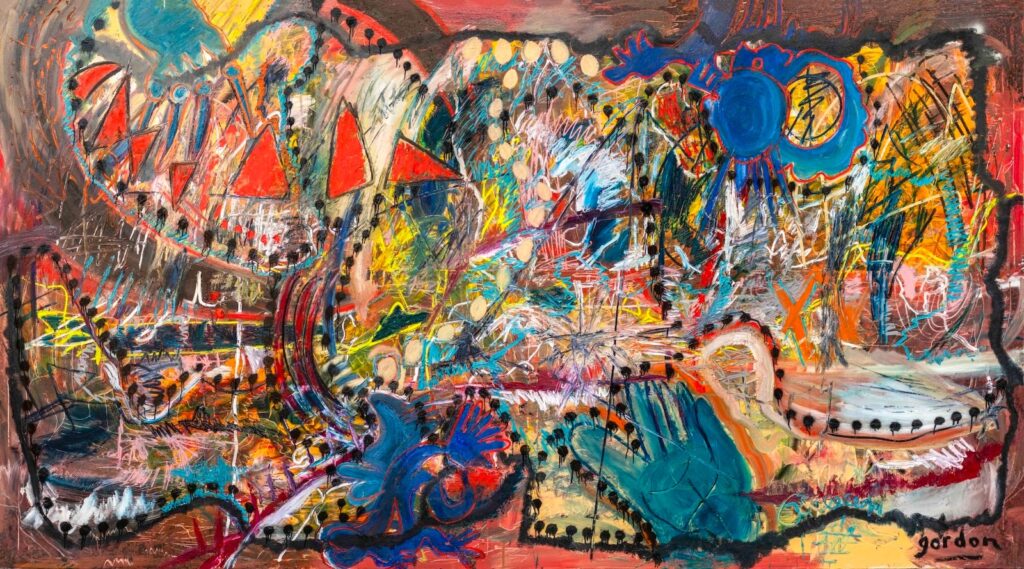
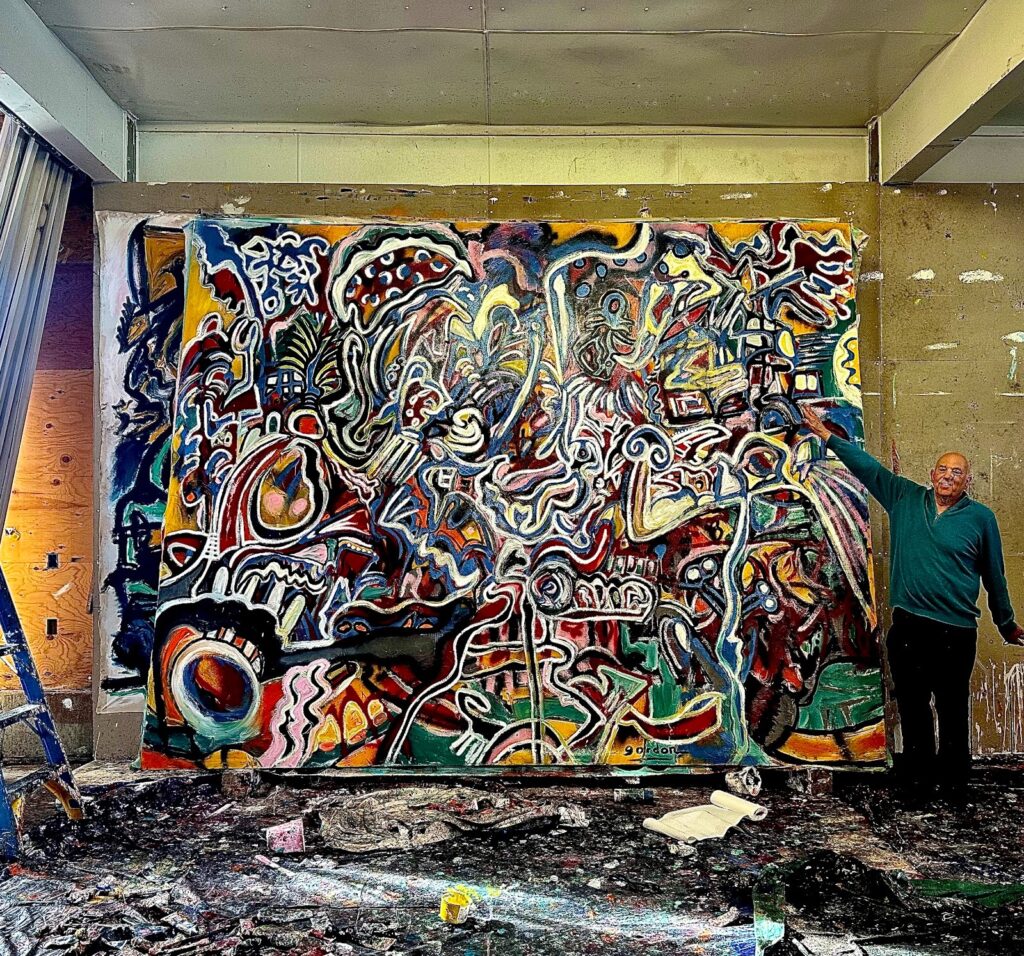
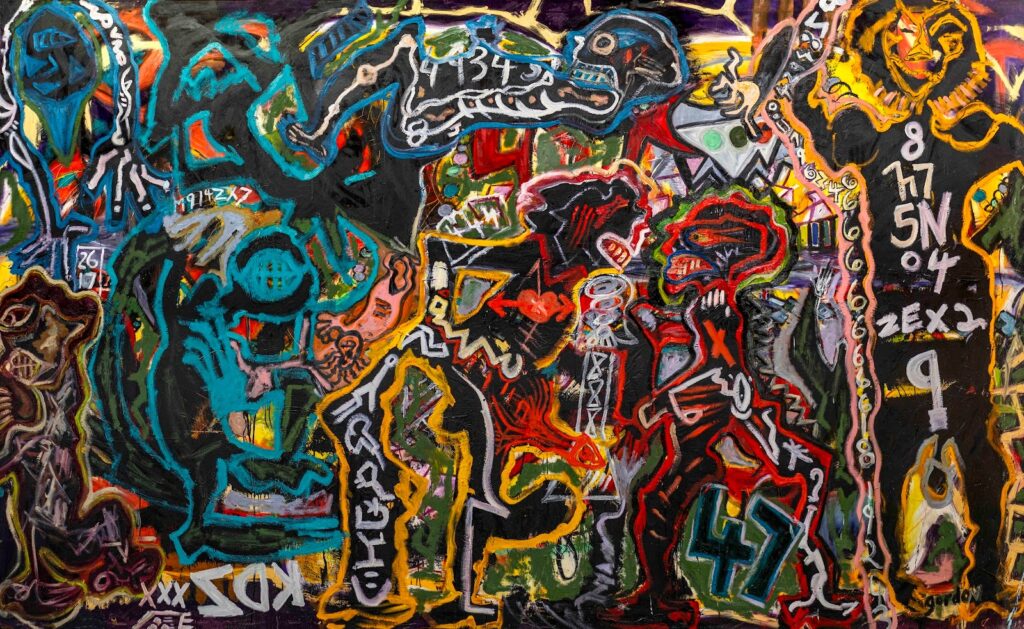
You call your process primal and anti-intellectual, yet works such as Three Gentlemen Discuss Nietzsche, The Valkyries and Somewhere in Asia Minor carry an entire archive of books, music and history. What happens when instinct meets everything you have read, watched and listened to?
This perceptive question forces me to perseverate lest I fall into self-contradiction! I believe that we are mortal corporeality and that everything else we attribute to the human miracle is self-aggrandizement. I reference the animal, the brute, the primitive thoughtless beast, but the deeper truth I believe is that we are inextricably complex organisms defined by everything that we have perceived in life plus a judge and a conscience.
That sublime everything dictates how and what we create in art. It is our limitation and our infinity. I do my best to summon my entire being, to shape it into a lightning bolt with which I electrify the canvas. That’s hubris, but hubris is vital to creative work. Though we are but material, we paint like God. I have said, “There’s the tube of paint, the canvas, and the sum total of your life. That is all.” That is how I try to paint.
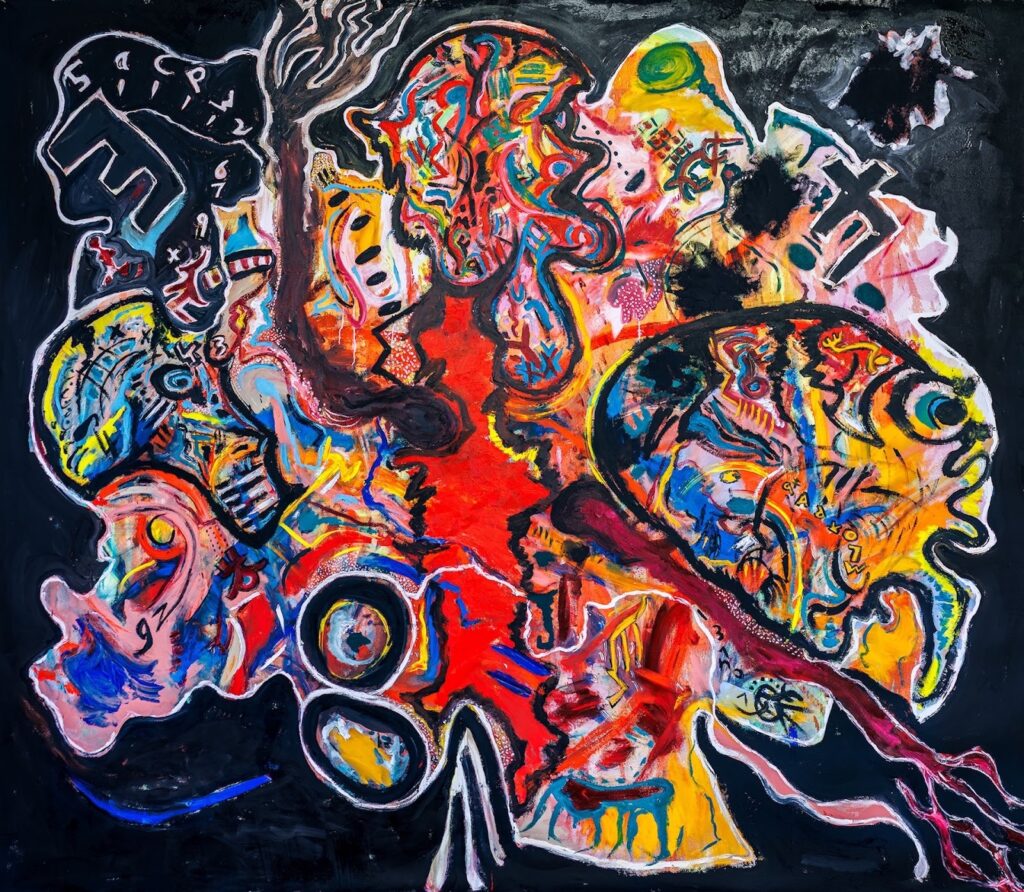
Of the twelve works you selected for ST.ART, which one feels least like the others? What does that exception reveal about where your practice may go?
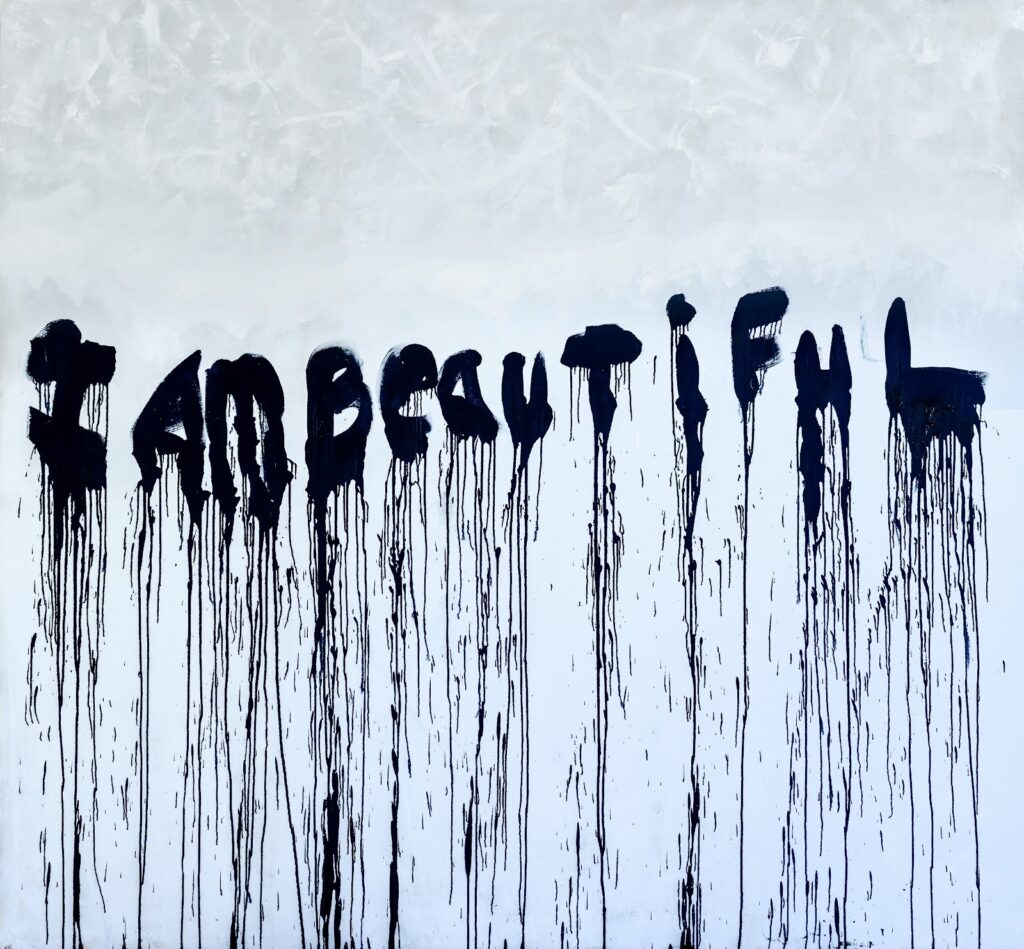
For its linearity, simplicity, and literalness, the piece titled “Beautiful”. With heavy eyes, interminably, I rocked before this impassive 8 × 8-foot blank canvas under the dark clouds of self-denigration, a common occurrence. With face in hands, despairingly, I mumbled the common invectives at myself: fraud, idiot, loser, fake until disgusted with self-defeatism my inner protector lunged from my chair and angrily scrawled in Mars black pain the words “I Am Beautiful.”
It was terrifying to write, like walking upon a glass plank over the Grand Canyon. This was not a painting but an exorcism. To make it factual, I dripped the black blood of struggle down the letters and added the white sky of enlightenment as an unrealized nirvana. I painted the phrase to exist in the purgatory between nothingness and supremacy.
You have described figures and stories surfacing midway through a painting. Is there an image that keeps returning even when you begin without a plan?
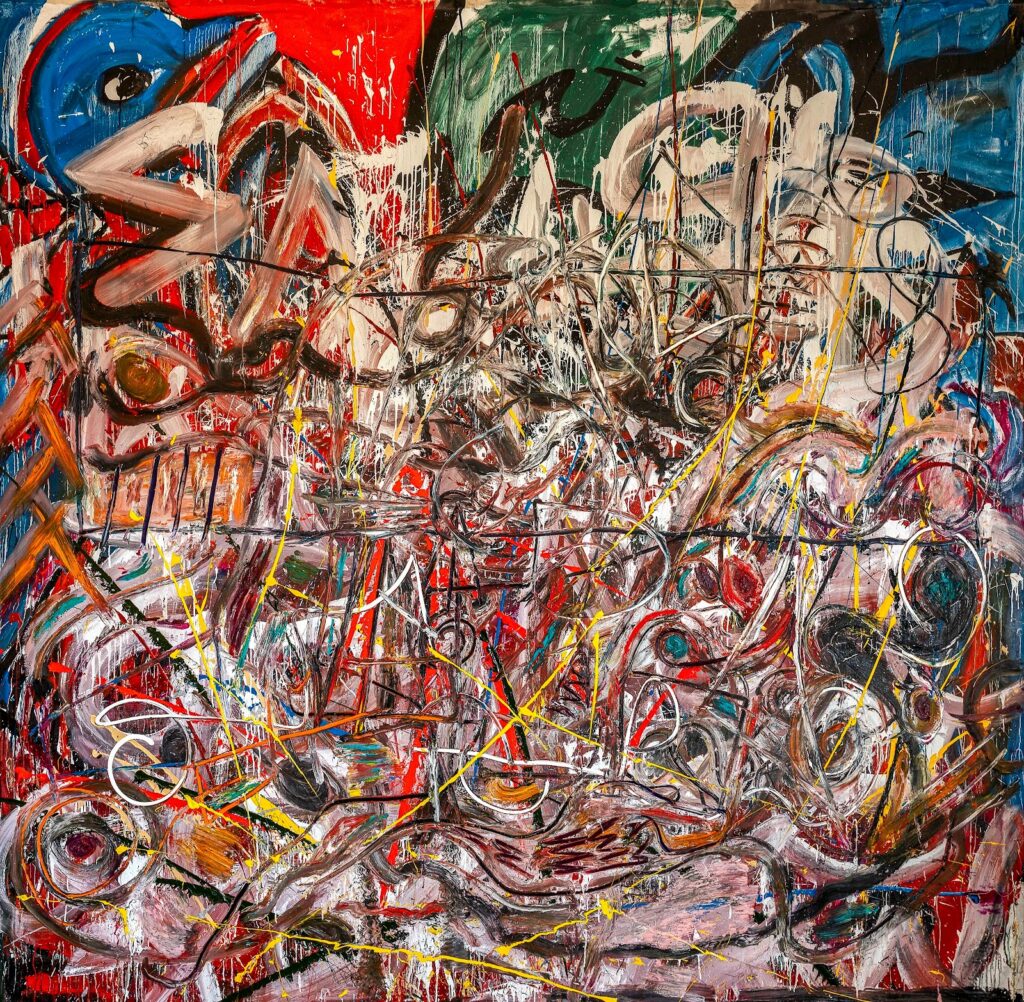
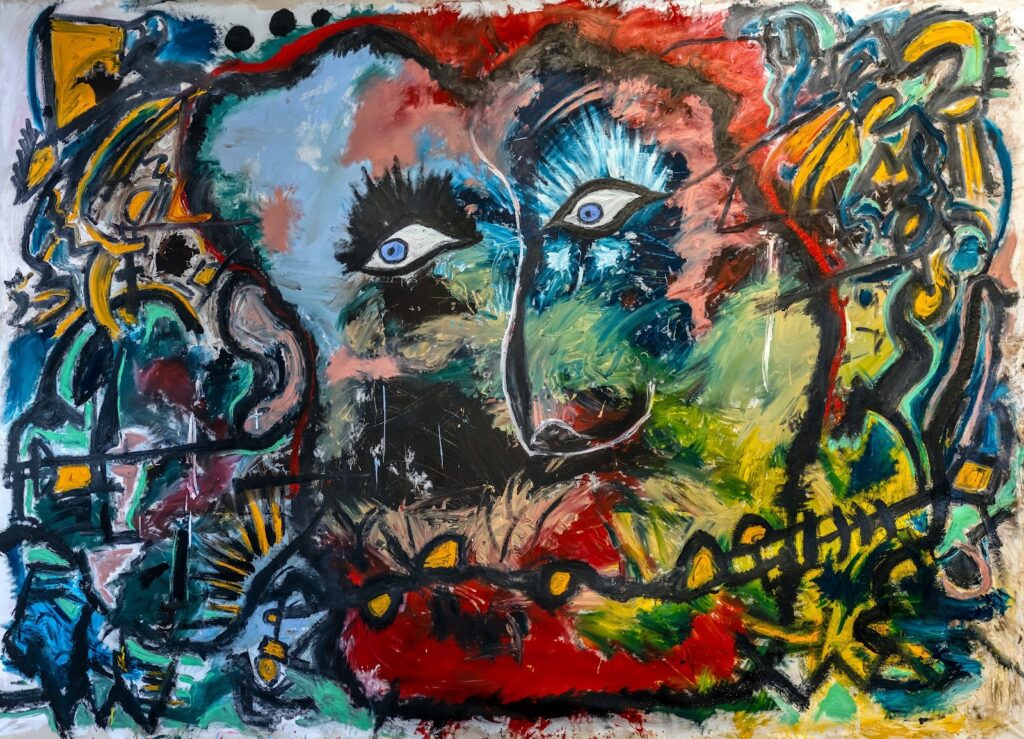
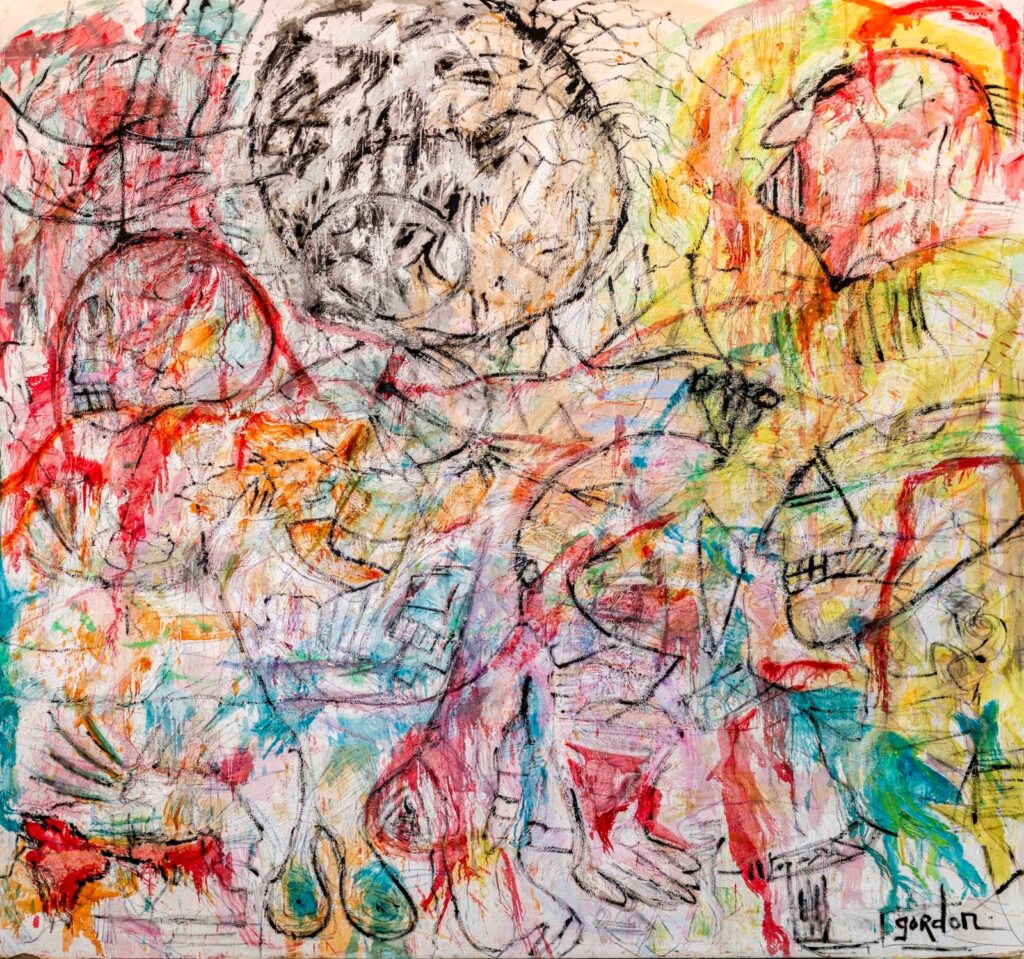
For its origin story, I trace with wash multi-colored arabesques, loops, streaks, and swipes of pure emotion until I cover the canvas. I rock in my chair studying the miasma until, perhaps slightly mind-enhanced, images emerge – a face, a head, an extended leg, two lovers, a drama. Now with a paint-loaded brush, often straight from the tube, I embellish the story until, deeply textured, it pulses and pops, as if alive.
In mid-process I title the work: Bluebird Drowning, Mugshot of a Joycean Scholar, Lust and Fragility, Woman in an Oyster, The Dubious Angel. The painting, then, solidifies, if I am lucky, into a work of art somewhere on the spectrum of decency. I most often discover exotic birds, angels, ghosts, indeterminate faces, gaping eyes. At some critical point I seize control from the work which heretofore controlled me – and I am master. And that feels right.
You recently wrote that a small painting can hold “packed gunpowder” as well as a large one. Has working smaller changed what monumentality means to you?
I do not think of “monumentality” as a size, but rather as a power. Starry Night, The Scream, Mona Lisa, Kandinsky’s Composition VII, Dali’s The Persistence of Memory, though they are small, exemplify monumentality in art.
But because I am a physical unlocked man, I prefer working the scale which allows me to paint with my whole body. I dislike chairs, easels, palettes, tensor light, preferring to describe wide arcs with arms, legs like a gladiator’s, thrust forward; to rumble and climb paint-encrusted ladders; to employ shoulders and hips in a St. Vitus dance; to stride horizontally while clasping brushes; to risk myself. It’s the joyous process big accords as much as the finished product. I treasure contact improvisation. Ultimately, I want the arms of my paintings to open out and enfold my viewers with their heartfelt messages.
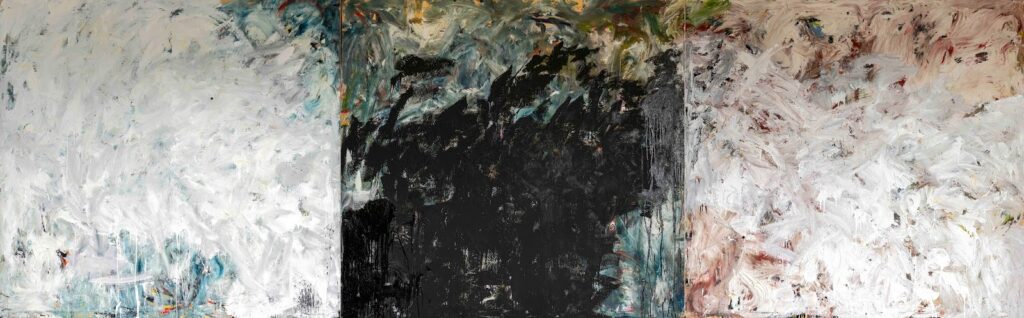
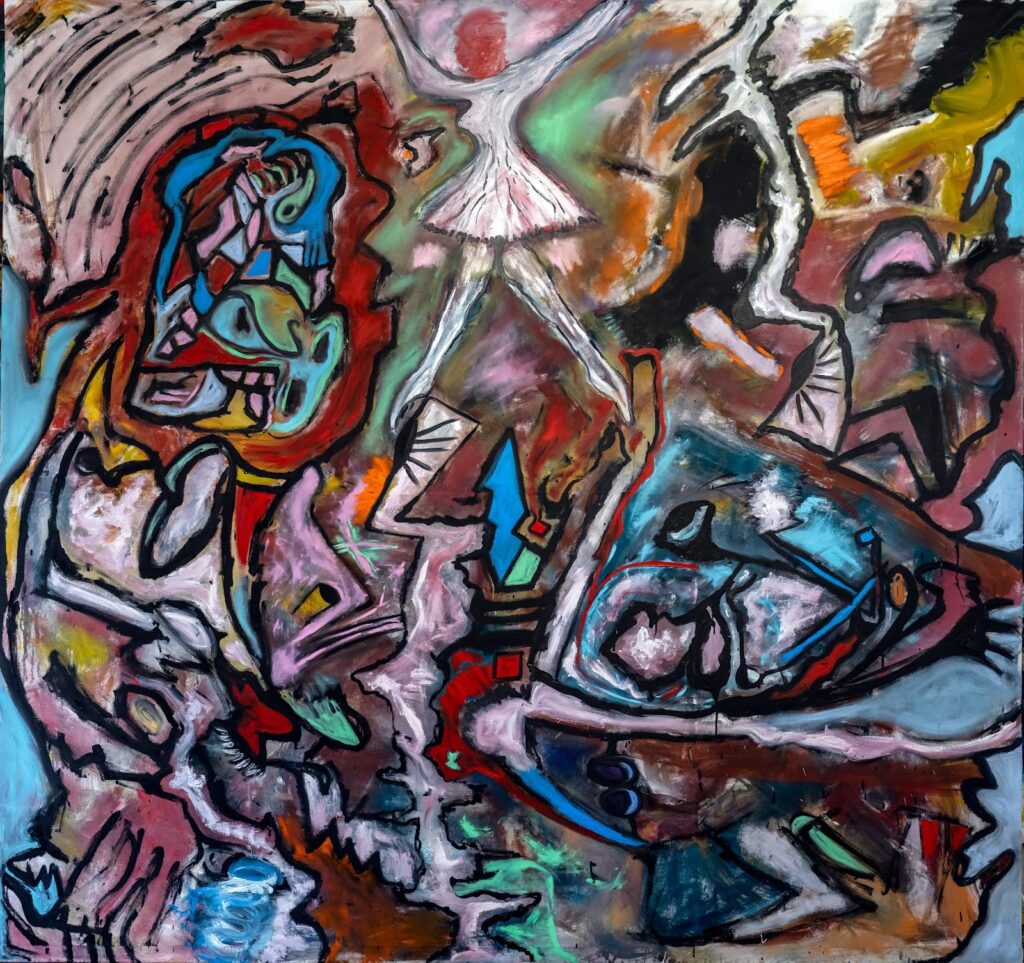
In the Mirror Paintings, you describe obliterating your own face. Once the work leaves the studio, the mirror reflects somebody else. What happens when the viewer enters that self-portrait?
Once upon a time I experimented with painting mirrors. Interestingly, I experienced the tip of my brush meeting itself inside my face. It felt weird and oddly profound. Each stroke altered my image until, unrecognizable, I wore worms of paint. When viewers experience these self-portraits they see the psychological machinations behind my mask, the brain itself in agitated motion.
Aortic Passion and Sculptural Thromboses make the body sound like a circulatory crisis. Why does the language of blood, arteries and blockage keep returning in your work?
Heat comprises passion. Passion comprises art. Veins, arteries, blood, thrombosis comprise the body. Therefore, the body must be my subject. The way it flows, the way it beats, the way it grows, the way it dies. I paint not abstract ideas but visceral emotion. Give me the cave dweller impulsivity of abstract expressionism. Give me primitivism, give me orgasm. Chop off a hand and watch it bleed. Sustain knife wounds and watch them contort. Kiss a lover and watch it melt. For me ideas devoid of flesh deserve no prominence in art.
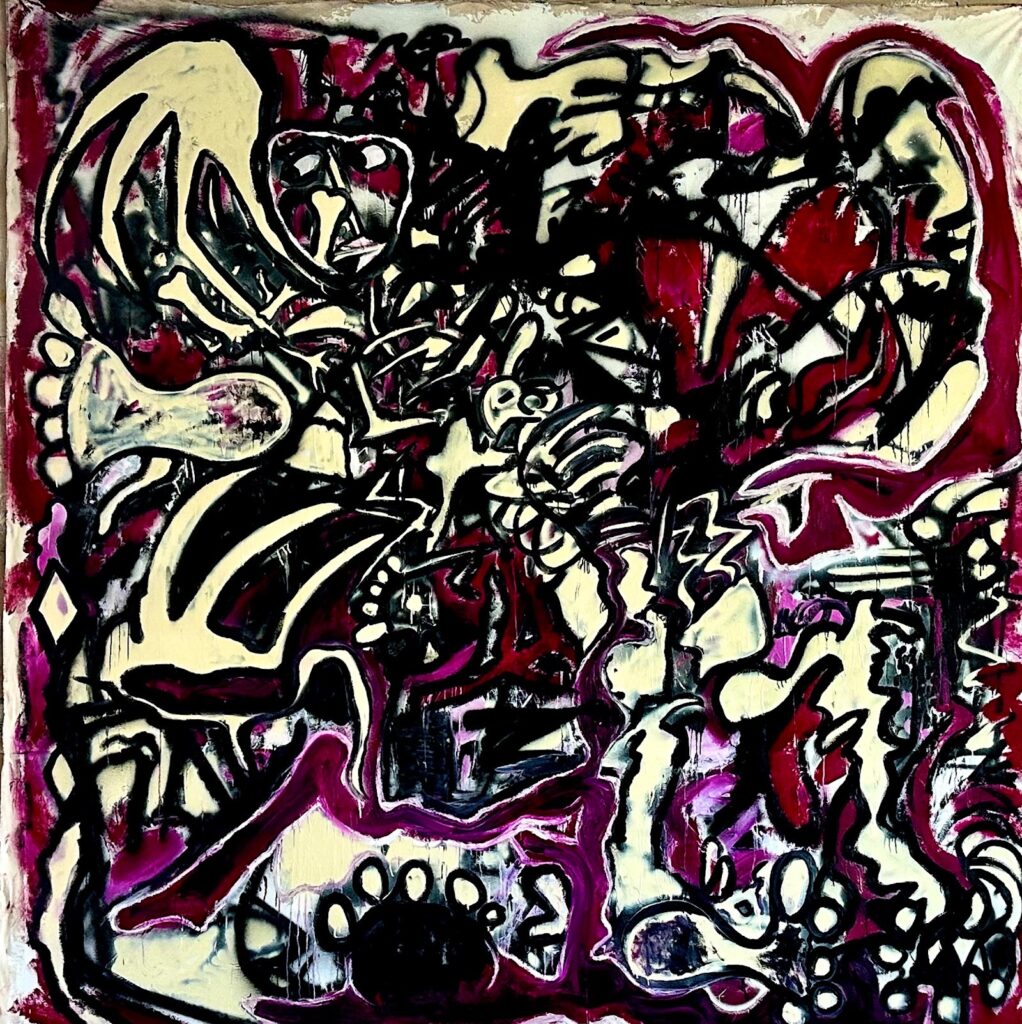
Titles such as Daphne’s Sugar High, Johnny Hot Pants and Three Gentlemen Discuss Nietzsche can be funny even when the paintings are psychologically raw. What work does that humor perform?
Titles may hint at my perspective on a subject. In Three Gentlemen Discuss Nietzsche, the curtain opens on three manorial charlatans in spats strolling a Parisian boulevard fatuously discussing the unspeakable sublimity of Nietzsche. After sipping hot hazelnut creme they find themselves in pedantic reverie believing themselves superior to the common man.
The title goads these characters, strips their delusions, exposes their fraudulence for the world to see. Ladies’ man Johnny Hot Pants strikes the world of women, like a shot cue ball striking the rack. He has no better moniker. Daphne’s Sugar High maps the brain flooded with the dopamine of a two-week-long ice cream binge that landed her homeless, driveling fudge sauce, clothes torn, hair knotted, toes bloody beside a city dumpster.
Sometimes my titles provide comic relief to tragedy. Sometimes they emphasize seriousness by cutting the legs from underneath that selfsame seriousness. Sometimes they’re just mundane labels. In all cases I use titles as tiny doorways to otherwise impenetrable edifices.
You have said that failure does not exist in your practice. What, then, happens to a painting that feels dead?
Failure cannot exist when no laws exist. When painting I restrict myself to no limitations, structures, or authorities. I free myself to enter Happyland where citizenry rejoices at experimentation, where everyone succeeds. Ethelbert tries to fly and everyone gasps with joy and applauds. Jimbo botches Rachmaninoff but audiences wildly ovate. In Happyland one cannot fail. Therefore, no painting of mine ever feels dead.
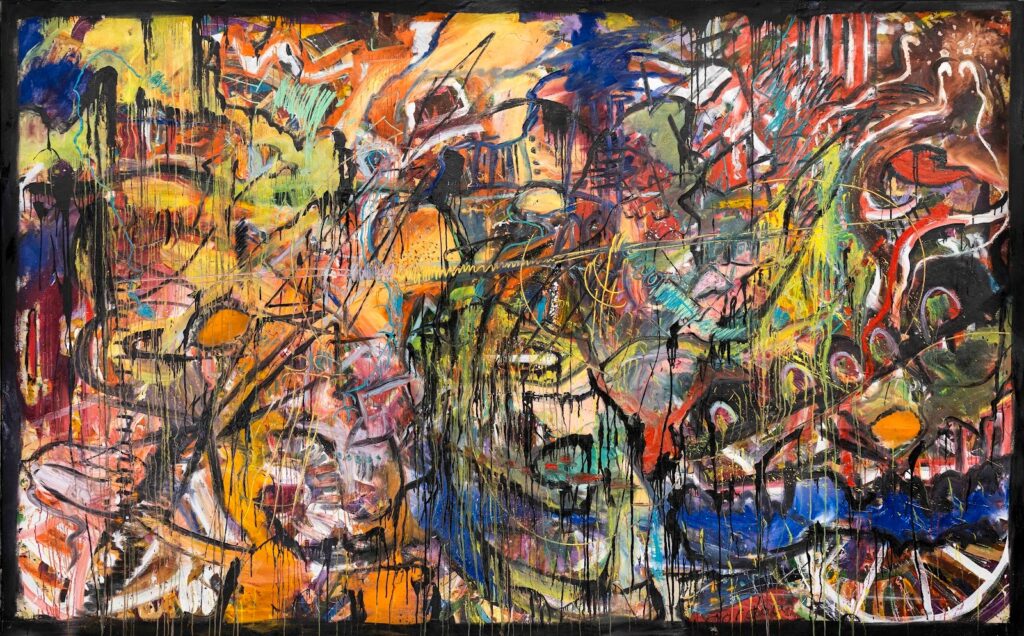
Your descriptions of painting often draw on combat, predation, sex and conquest. What does masculinity mean inside the private mythology of your work?
Grindingly, I see life as biology. What are we, I postulate, but nervous systems armored in skin, muscle, and bone. Battlefields mangle, crashes dissever, bombers liquify nothing but susceptible material. Sometimes my works rejoice at the spirit within. Sometimes they expose our carapace of ineffectual bone – ribs, skull, pelvis, patella. I paint the Darwinian struggle: who vanquishes the enemy, who fills his stomach, who mounts the females, who wields the power. Perhaps the iron core of masculinity is but a question of dominance, fitness, and procreation. My work entertains this possibility. My private mythology does not reject it.
How familiar are you with the Russian avant-garde, where abstraction often grew from theory, geometry and collective ideas? What, if anything, do you recognize in that tradition from inside your own anti-systematic approach?
I admire Malevich, Kandinsky, and what little I know of Natalia Goncharova, Mikhail Larionov, Lyubov Popova, among the many. I’m superficial here. I have invented my own anti-systematic cosmology consisting of a non-geometric, theory-less, instinctual underpinning. Anything goes with me. I’m loose and dangerous. That’s it.
You told ST.ART that you were excited to enter the Russian art scene. What kind of conversation do you hope the work can begin here, beyond simply reaching a new audience?
With no humility, I want the world, Russia included, to behold a fresh new art form. A freestyle art consisting of the analysis and comprehension of every second of one’s life experience. Anything goes. Nothing is forbidden. The canvas is God’s void with which to create the world.
You have described all your poems and paintings as one continuous work devoted to “Who, Why & What.” Which of those three questions feels most urgent to you now?
“Who” unlocks all doors.