
Walking through the cool, echoing halls of Palazzo Grassi, I entered Tatiana Trouvé’s The Strange Life of Things — an exhibition that feels like stepping into a fragmented mental landscape. Her works combine drawings, asphalt, bronze, glass and even shoes that seem to float somewhere between “a pre-human past, a turbulent presence, and a speculative future.” Time feels suspended, and familiar objects take on new, symbolic weight.
On the other side of the Grand Canal, at Punta della Dogana, Thomas Schütte’s Genealogies presents a powerful contrast. Here, massive bronze sculptures, ceramic figures and delicate drawings dominate the space, creating a world that is bold, ironic, and physically overwhelming. Where Trouvé shows quiet introspection, Schütte confronts the viewer with ambiguity, tension, and dark humor.
Seeing both exhibitions in one day felt like moving between two psychological states — the internal and the external, the intimate and the monumental. By placing these two exhibitions side by side, I found an opportunity to explore how contemporary art can approach themes like presence, memory, time from two sharply different but equally compelling perspectives.
Tatiana Trouvé – a world outside time
There’s a stillness in Trouvé’s exhibition — a kind of suspended time where objects seem to remember things even when no one is around. It felt like being in someone else’s dream — one made not of clear images but of reminiscences and moments existing beyond the limits of start and end. The rooms don’t lead you through a linear story; rather, they drift you through atmospheres. Her “repertoire” of materials is surprisingly ordinary — chairs, blankets, books, shoes, bottles combined with asphalt and marble, bronze and glass. At first glance, these seem like simple objects, but by the time you reach the end, you realize that what appeared familiar carries a strange charge, as if they were relics saved from another life. In this space, time doesn’t progress, it hovers.
Ph. Marco Cappelletti and Giuseppe Miotto
Marco Cappelletti Studio
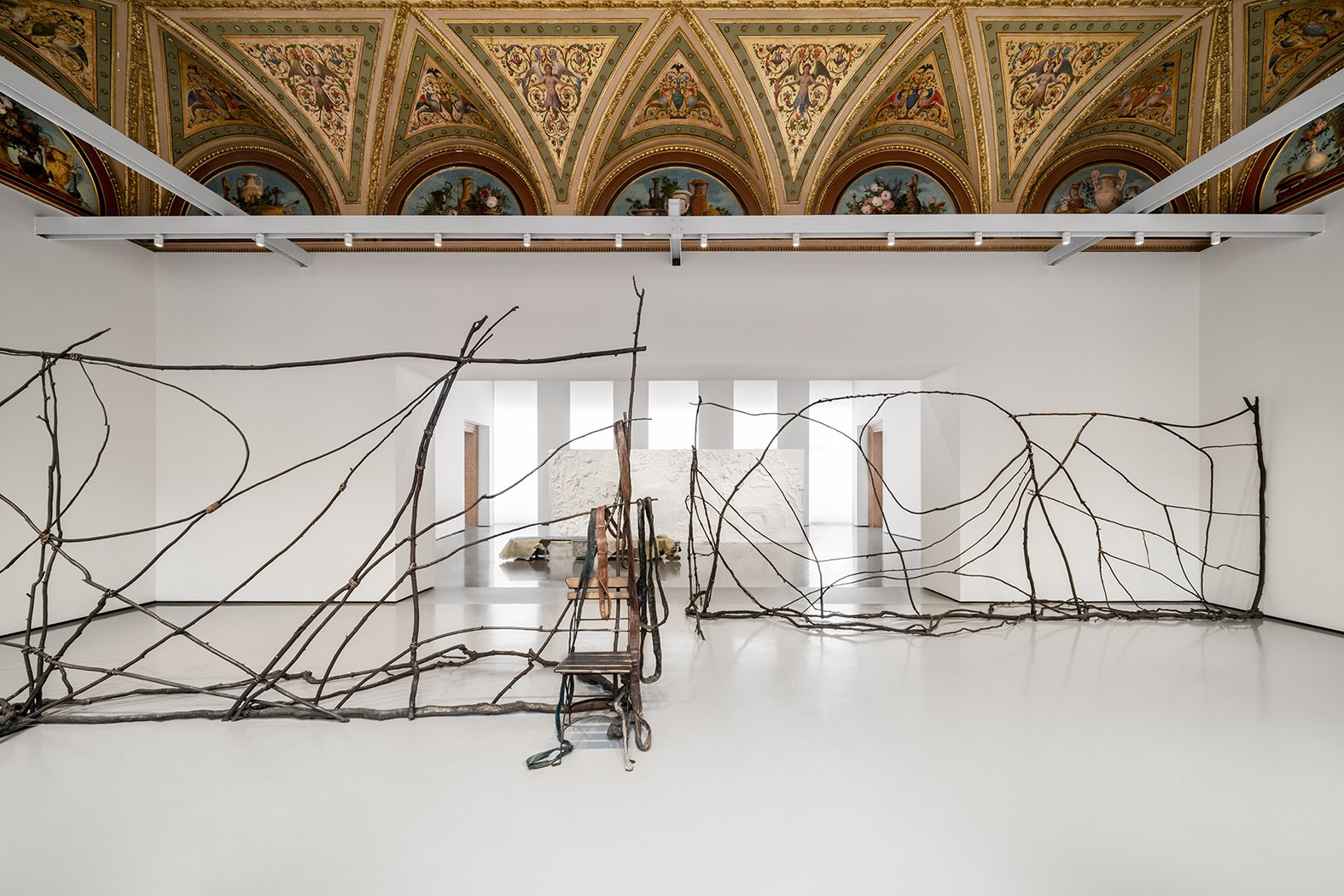
A bit further from the entrance, Navigation Gates sets the tone. Two wide gates made from cast bronze branches stretch across one of the palazzo’s largest halls. They evoke nomadic shelters and ancient navigation tools used by Pacific islanders — systems of orientation based on memory, wind, and movement, not on machines. Passing through them doesn’t feel ceremonial so much as suggestive: the idea of stepping into an alternative logic of space and time. Trouvé creates a sense of overlaying so that people have different spatial experiences.
Ph. Sofiya Kim
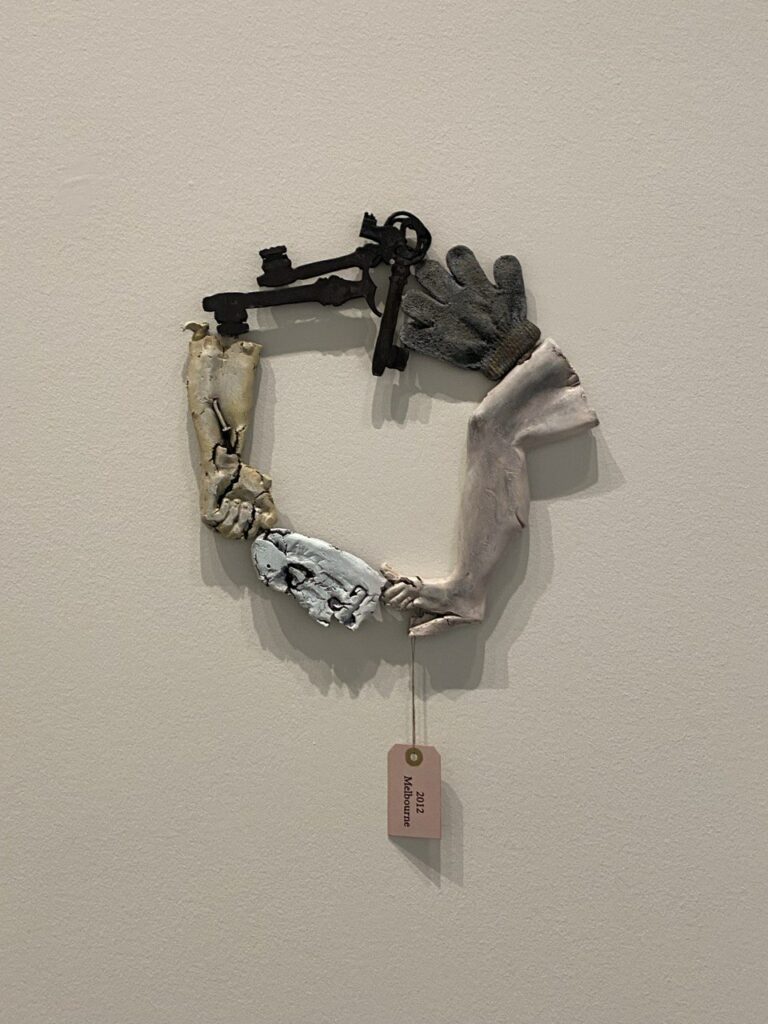
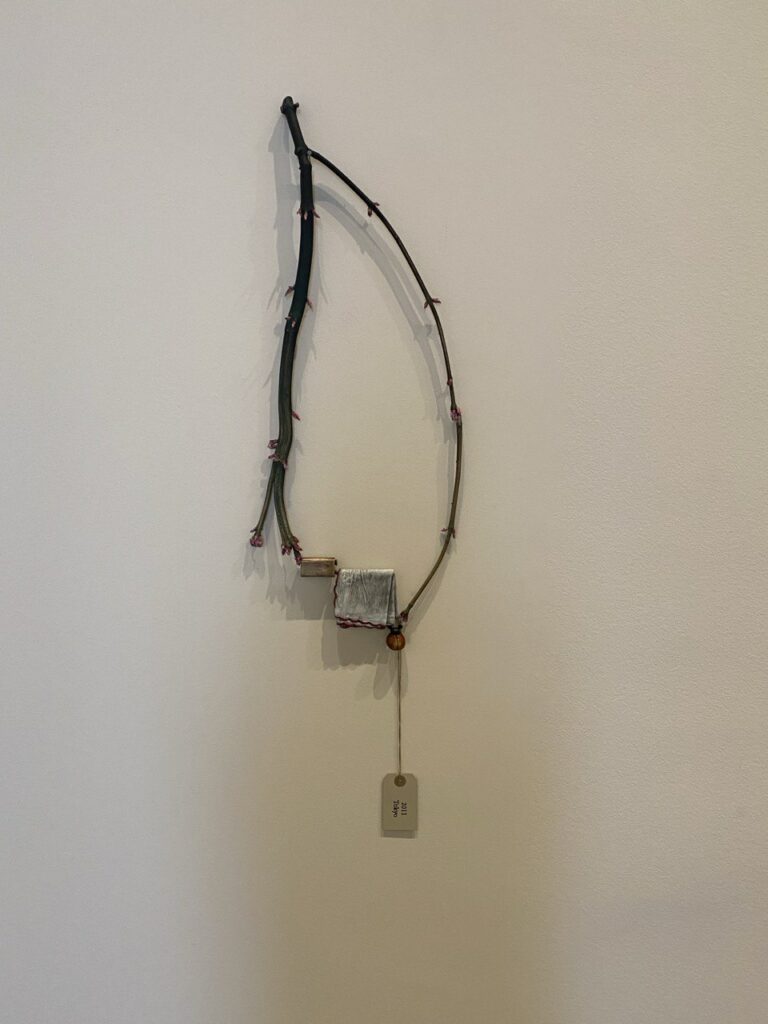
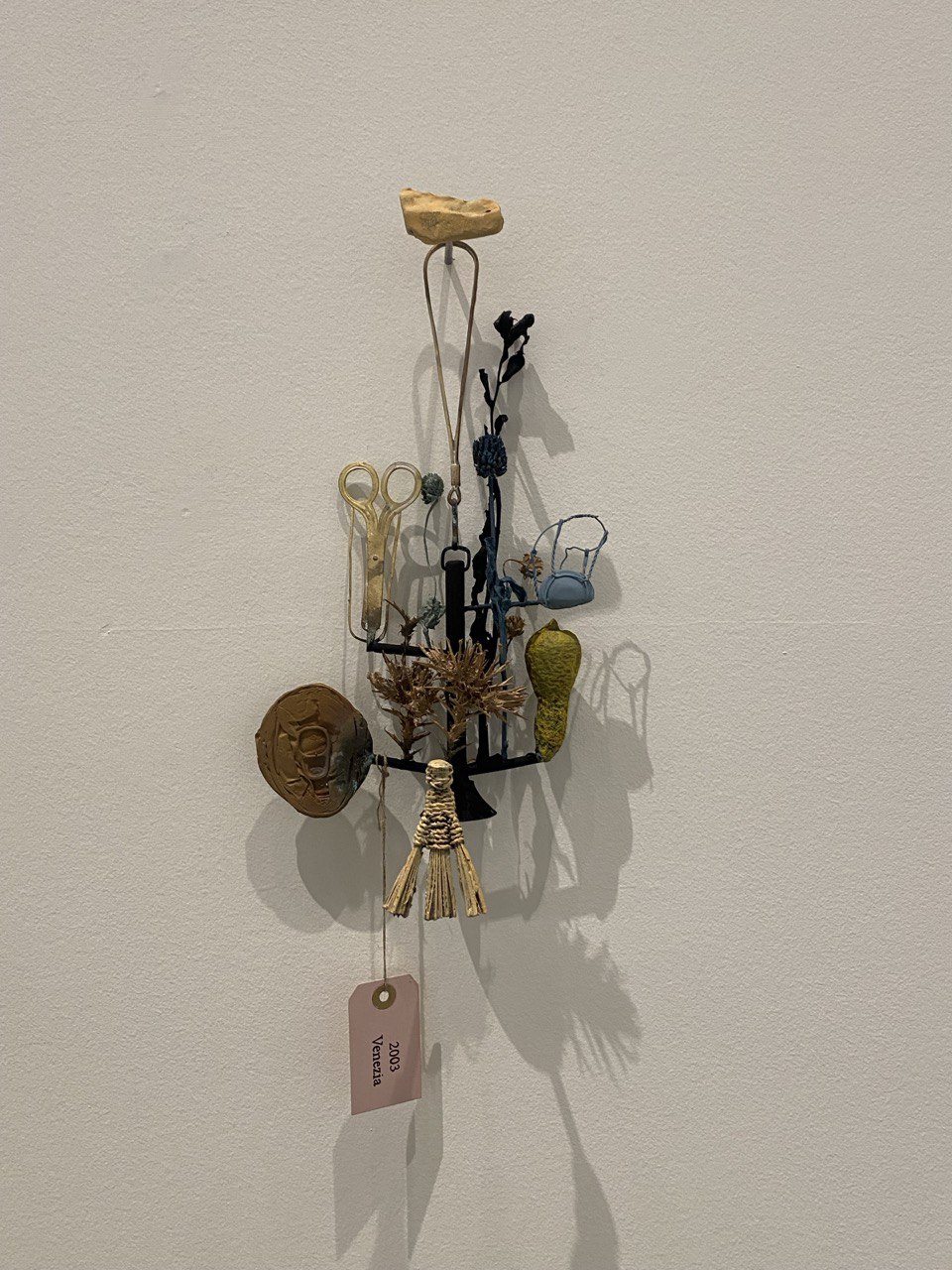
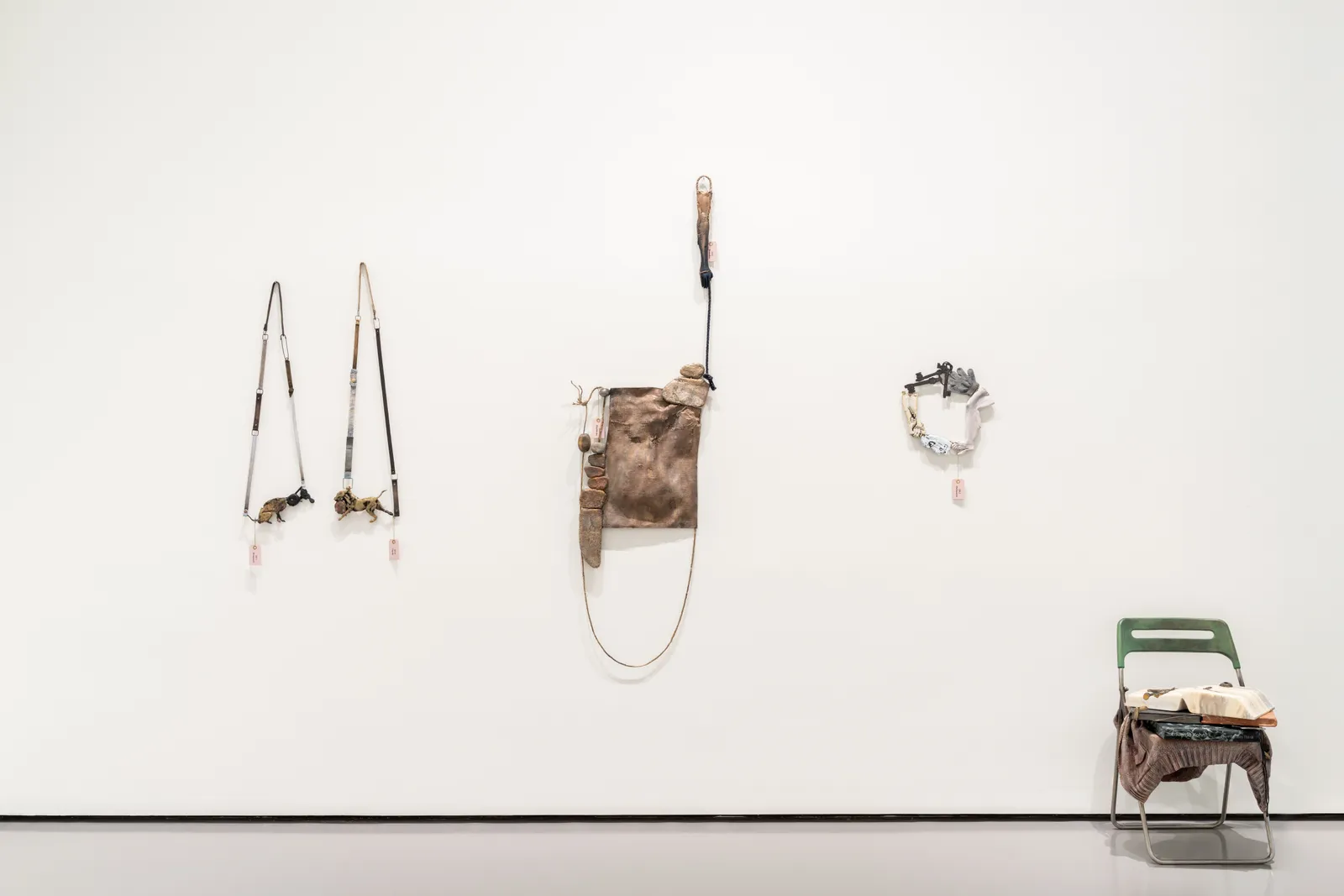
That sense of quiet drift continues in Cities, not far away from the Gates, a series of necklace-like sculptures made of “souvenirs” (stones, flowers, keys, gloves, cigarette lighters etc.) which she has collected over time. The longer you look, the more they feel like markers of time — personal and strangely eternal; they remind us that even the smallest things can be filled with meaning and memories we didn’t know we still held.
These works are linked to the city of Clarice from Italo Calvino’s “Invisible Cities”, a place that passes endlessly through collapse and rebirth, where survivors sift through ruins, collecting relics and fitting them together. Trouvé’s casts, made in enduring materials like bronze, preserve the shape of fragile things — a branch, a feather, a dried leaf — offering not just protection from rotting, but a compression of lived experience into physical form.
When I see a stone,” Trouvé has said, “I see how a world has been sedimented.”
Like Calvino’s cities, her works are accumulations of time, of memory turned material. The same way, talking about her thoughts on connecting the works to specific writers and topics, I couldn’t help thinking of Proust’s “madeleine” — how an object, innocently encountered, can trigger entire inner worlds. Trouvé’s “necklaces” don’t explain themselves, but they open a space for that kind of involuntary remembering.
Ph. Marco Cappelletti and Giuseppe Miotto / Marco Cappelletti Studio
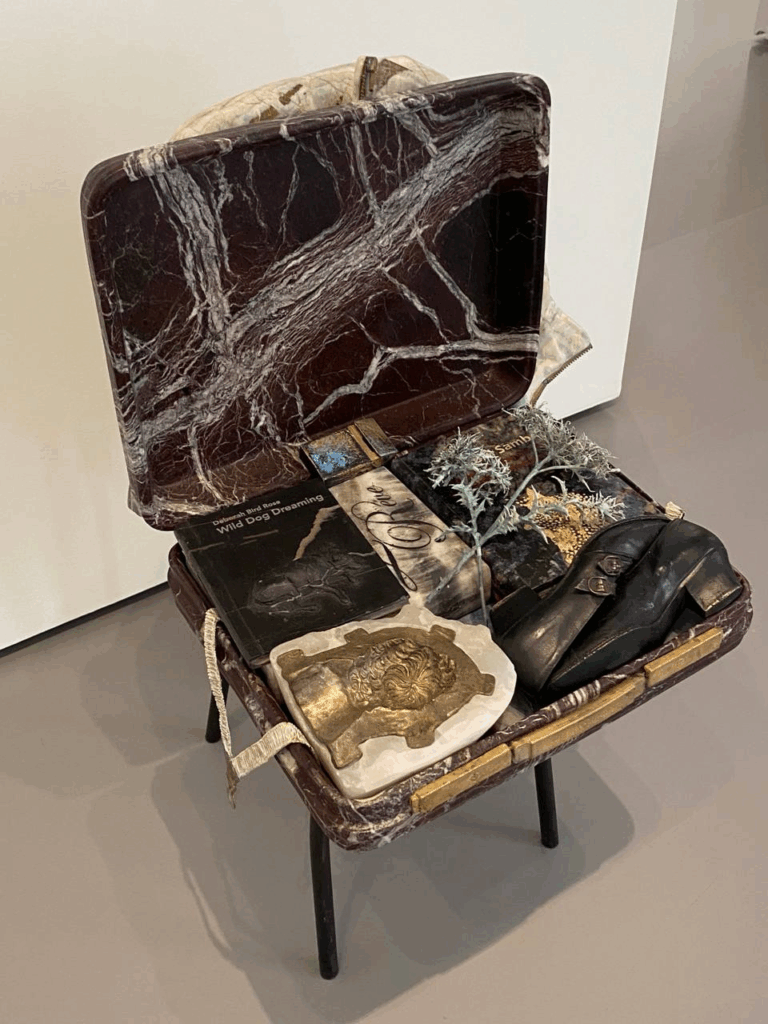
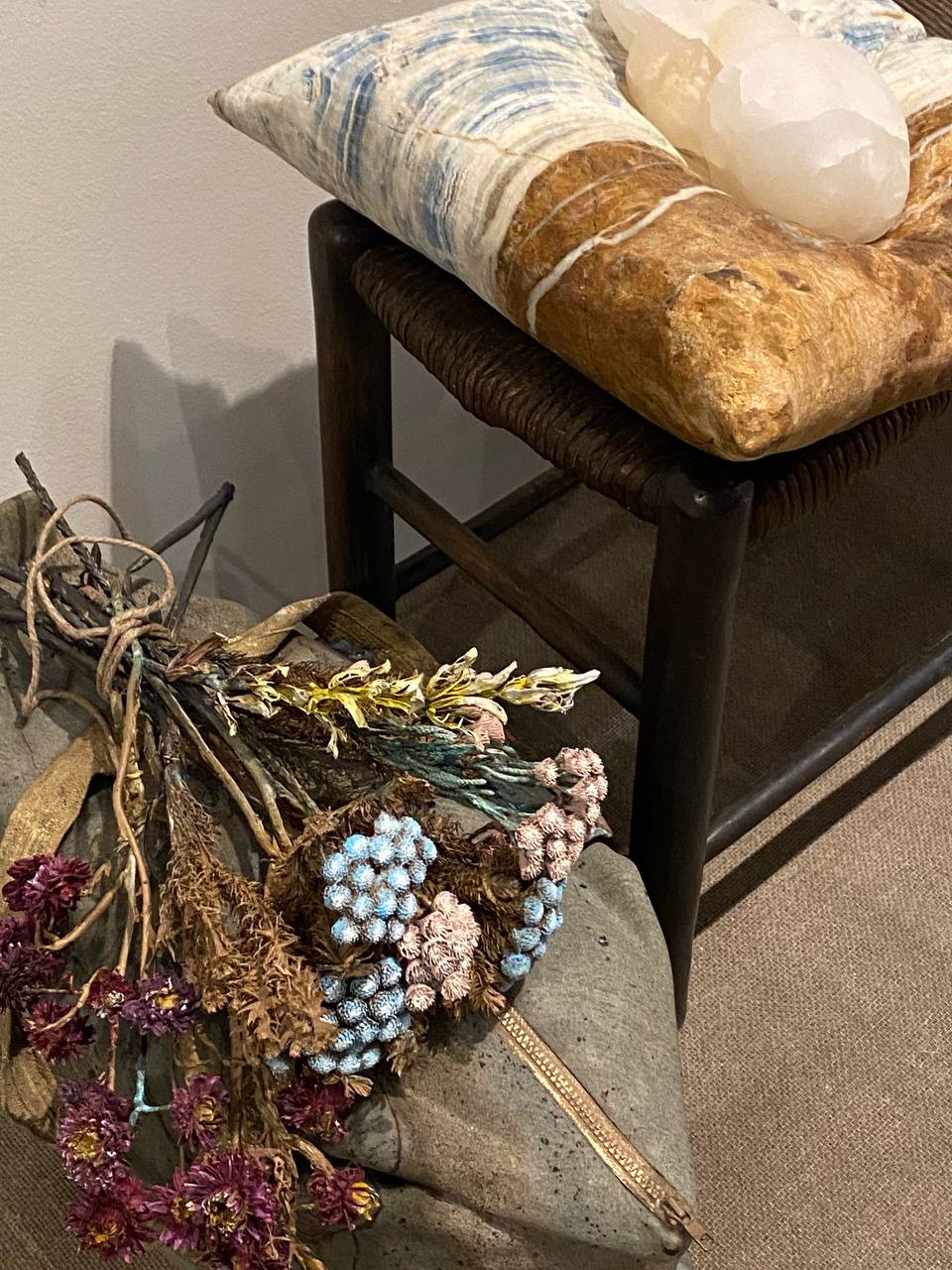
That idea of presence through absence runs through the Guardians series, which appears like quiet sentinels throughout the exhibition. Each consists of a chair and a small constellation of personal objects — a scarf, a bag, a shoe, a coat — all, of course, are sculpted from stone, marble, or cast in bronze. Initially, they seem to suggest someone has just stepped away, that life has just left the room. But the more time you spend with them, the clearer it becomes that no one is returning or, probably, no one was ever there. These sculptures don’t speak loudly; they watch, they wait, they create space. They seem to guard not just the palazzo or the rooms, but something deeper — private histories and quiet thoughts.
Ph. Aurelien Mole, Sofiya Kim
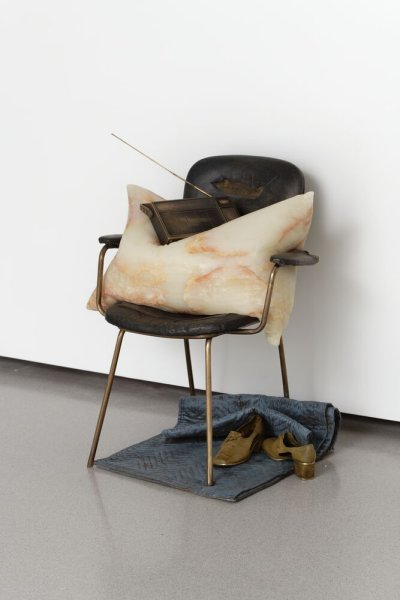
What’s striking is how each Guardian feels different, despite the repetition of form. One evokes a sense of protection, another seems steeped in thought, while a third carries the stillness. The books they guard are not random; many are written by women, many concern science, politics, and philosophy. These choices feel deliberate, like a gesture of care.
Trouvé herself has said, “The lives of my Guardians will always remain to be imagined,” and that’s what makes them powerful. They are not monuments to what has happened, but to what could have — to the unknown and the unspoken.
Standing before them, I found myself projecting stories of people I’ve known, books I’ve read, memories that, maybe, don’t quite belong to me. In this way, the Guardians become containers of absence, “keepers of culture and holders of beliefs in a different future”. They sit silently in the corners of the room, yet they seem to show whole worlds.
Ph. Florian Kleinefenn
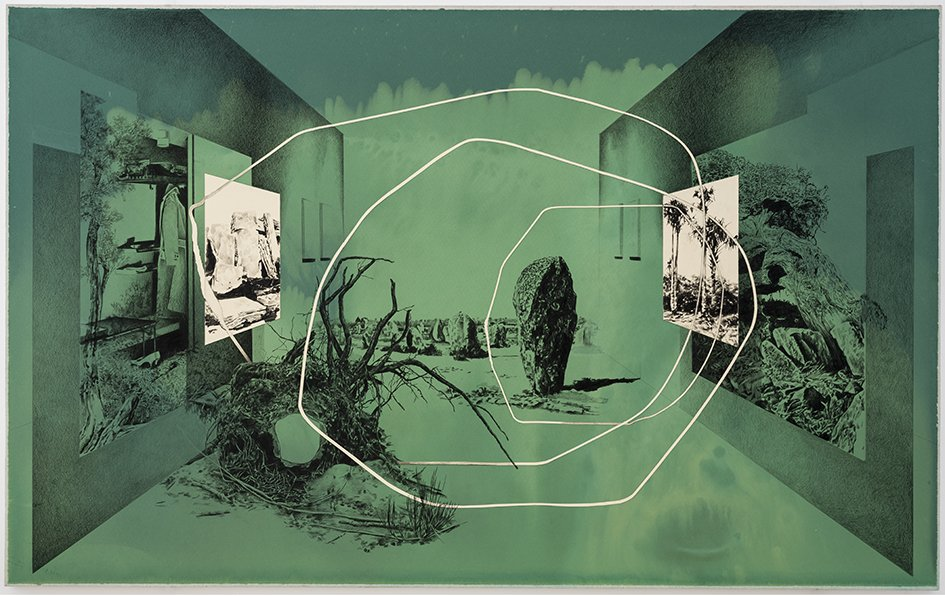
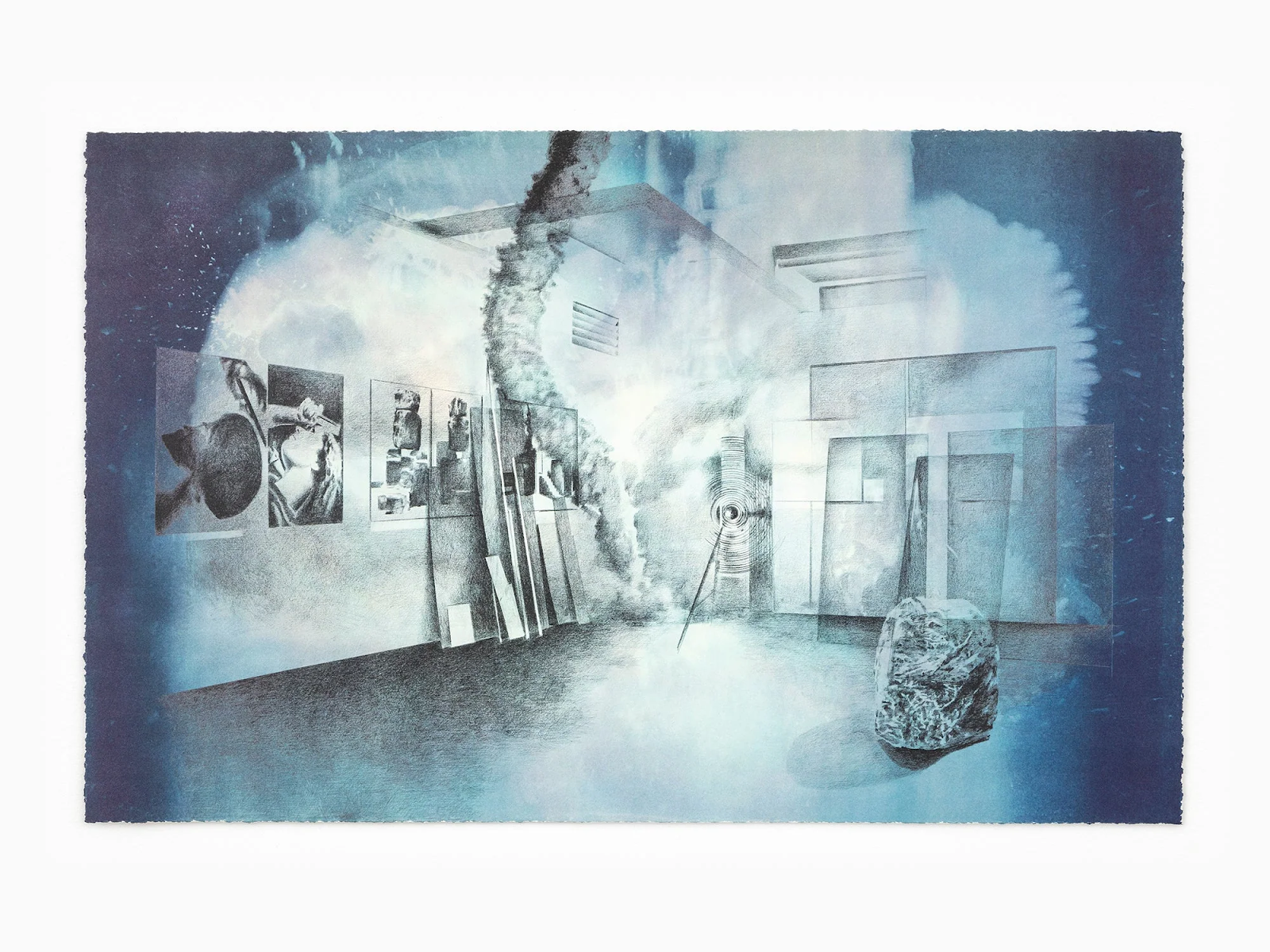
Last but not least, Trouvé’s drawings. As I moved deeper into the exhibition, I realized that these works weren’t just supporting works, but echoes of a sculptural world running parallel to the one downstairs. Some of the same objects appear — chairs, radios, trees — yet now they float inside spaces more intimately. Many of the works come from the series Les dessouvenus, a title borrowed from the Breton language, referring to those who have lost their memory, and the drawings carry that exact tone: memory attempting to take form, like dreams we can’t quite put together after waking.
The drawings are made on large sheets of colored paper that have been immersed in bleach baths, washing the surface resulting in unpredictable stains, like the marks left by time or loss. Trouvé then intervenes, sketching pencil lines across the surface. You can feel both a tension between construction and erosion, a connection between memory and disappearance. Some works contain nature: mountains, branches, even minerals. Others look like rooms after a silent hurricane that went through them with the objects left behind mid-thought. In this context, drawing becomes a form of excavation — of spaces, of feelings, of time itself.
Ph. ArtSpace.com
I kept thinking not of the future, but rather about how the drawings trace not so much a memory as an unwillingness to remember — they’re not trying to imagine what’s coming, but instead to follow the half-remembered layers of a world that has already slipped away — “places and spaces Trouvé has dreamed, observed, and imagined.”
Thomas Schütte – form, weight, absurdity
If Trouvé’s exhibition felt like going through someone’s mental landscape — slow and suspended — then entering Thomas Schütte: Genealogies at Punta della Dogana was like stepping into the open air. Schütte’s materials are as varied and contradictory as his subjects. Bronze, ceramic, aluminum, steel, glass, clay — all coexist in works that rotate between the monumental and the fragile. His sculptures don’t just inhabit space; they take it over with a mix of power, absurdity, and discomfort. Oversized heads grimace. Enormously huge ghostly figures. Even the pedestals feel weighty, like obstacles rather than supports. However, beneath all this theatricality and humor, something human surfaces — a tension between control and collapse.
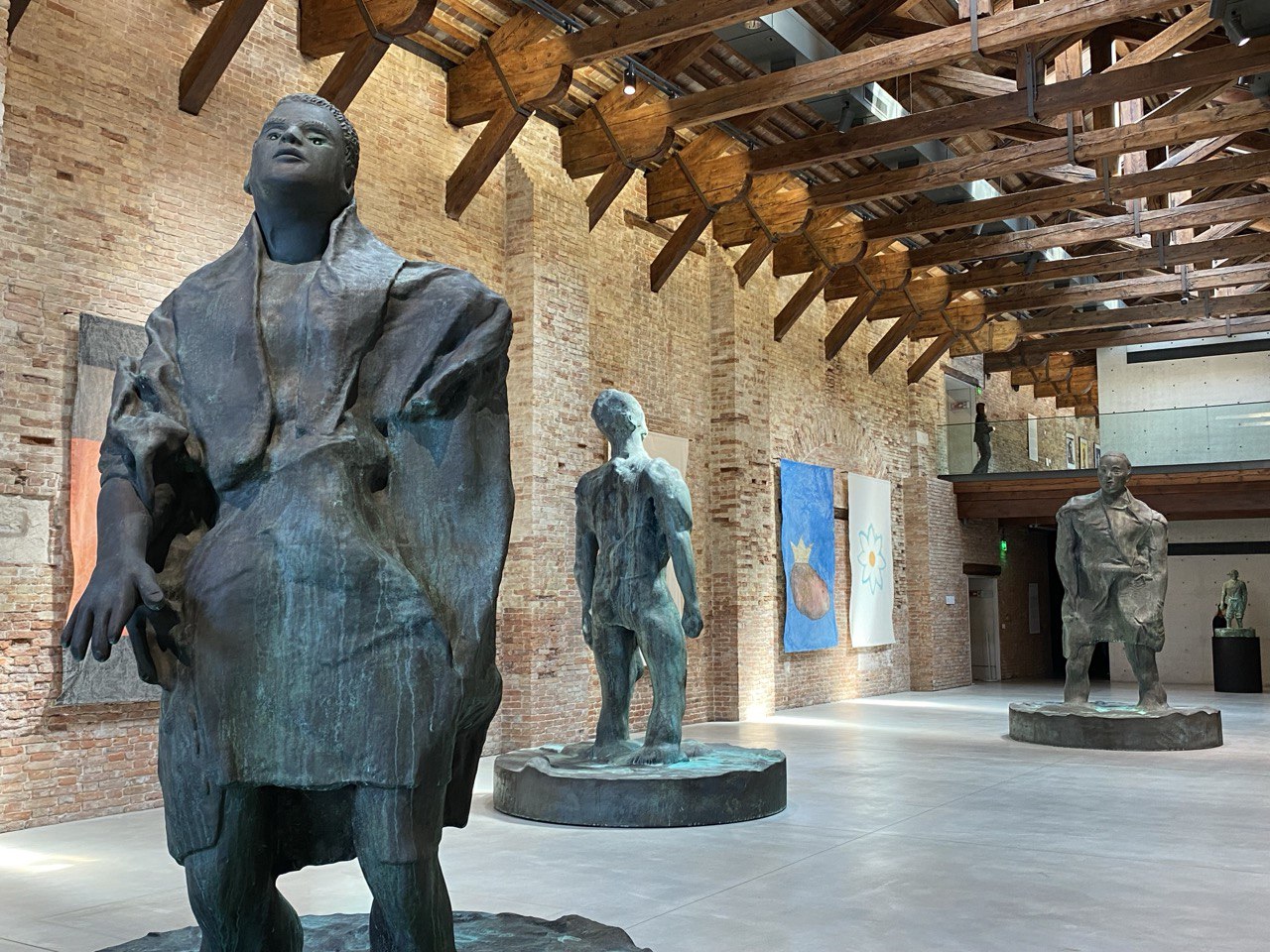
Take Mann im Wind I, II, III (translated in the catalogue as Man in the Mud), a trio of monumental bronze figures that seem to be trying to walk, yet permanently stuck in their pedestals. It’s almost comical how these hulking men, half-heroic, half-ridiculous are unable to move forward with their size and power, but the more time you spend with them, the more poignant they become. They start to resemble monuments not to motion, but to paralysis. “An ode to failure and perseverance”, they embody the quiet tragedy of wanting to act but being held back by invisible weight — one of Thomas Schütte’s major themes.
Ph. Sofiya Kim
A story lies behind the creation of Men in the Mud: while trying to stabilize the wax figures so they could stand upright, Schütte ended up sinking their legs into blocks of wax. What started as a practical solution became something far more expressive. It shows how Schütte embraces failure, awkwardness, and accident, transforming what seems clumsy or failed into something full of meaning — all creates a part of what makes us human.
Ph. Marco Cappelletti / Marco Cappelletti Studio
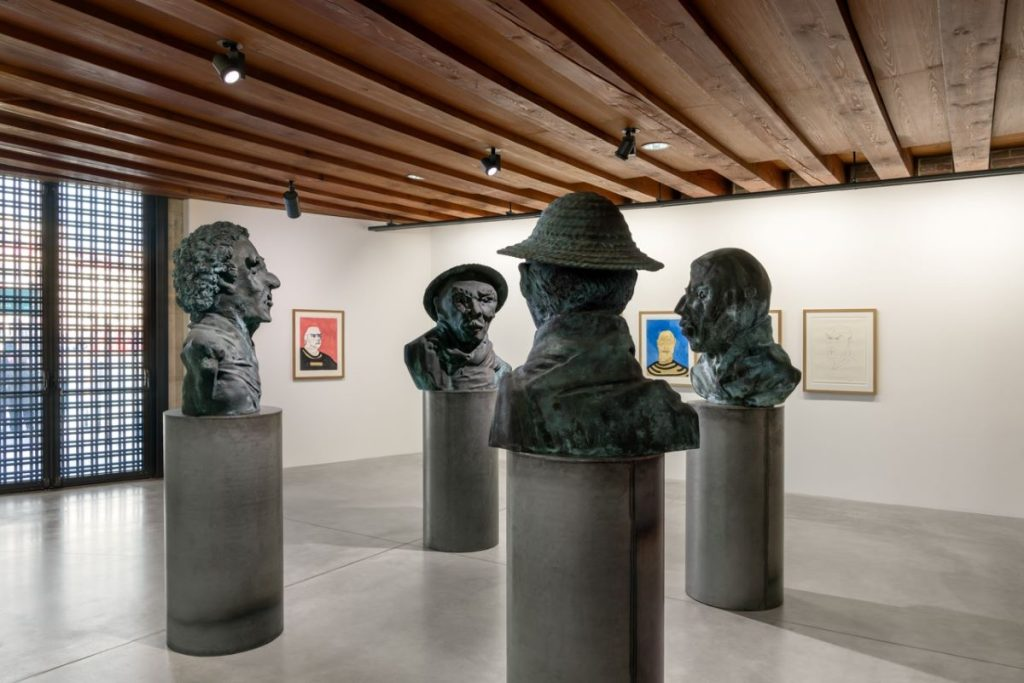
Nearby, the Fratelli (Brothers) grab attention with their massive ceramic heads, each twisted into a grimace, a sneer, a smirk. They feel like caricatures, partly a Roman bust, partly cartoonish, but their expressions carry real emotional weight. Arrogance, guilt, shame, panic — it’s all there, frozen in glaze. Schütte, while being in residence in Rome, based them on figures ranging from elderly people seen in public transport to modern politicians, and they seem to represent a timeless corruption. They’re funny, yes, but there’s also something uncomfortable about them — their twisted faces suggest something darker underneath. The strange, exaggerated shapes don’t just make fun of power; they show how it can look distorted and fragile at the same time.
Ph. Filippo Rossi / Marco Cappelletti Studio
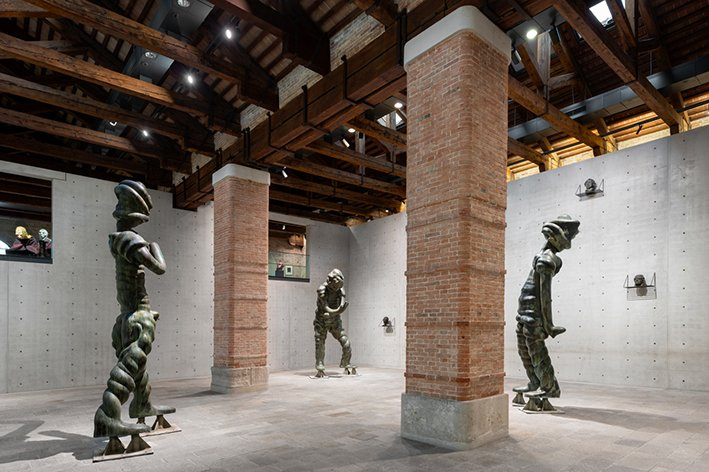
Then, the feeling of silence returns with Drei Ganz Große Geister (Three Very Large Spirits) — three towering, ghost-like figures, each around five or six meters tall, standing in the middle of a vast, empty room in shining cast aluminum. They have no features, no expressions. It’s hard to tell what exactly is happening between them. Are they confronting each other? Waiting for something? Or simply existing together?
These spirits don’t look like gods or warriors. They seem more like watchers or lost souls, as if they belong to a forgotten story. Maybe grief with a given form. Maybe just the shape of time, standing still. Their size is overwhelming, but not aggressive. Instead of dominating the space, they seem to absorb it; they stand as if they were frozen. You feel like you’ve walked into a moment that’s been paused.
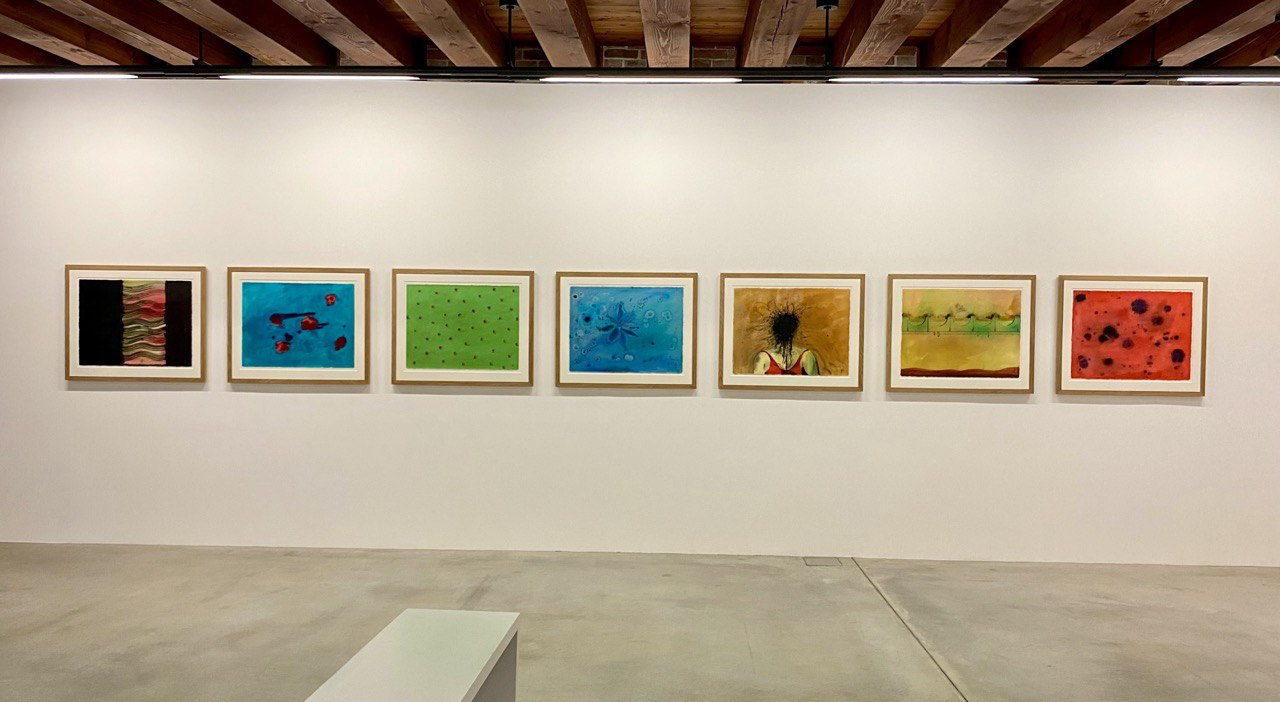
Beyond these art works, Schütte’s drawings add another layer to the emotional part of the exhibition. If his previously mentioned sculptures carry some symbolic weight, Schütte’s drawings offer something else: a kind of quiet intimacy. Everything seems to start here, with just a pencil or brush on paper. Despite his own modesty:
I can’t draw,” he says, then later, “I can do nothing but draw.”
Ph. Sofiya Kim
What I admire is the willingness to leave things open and unfinished. Schütte once compared drawing to making a meal: a simple gesture full of care, requiring just the right amount of everything — “not to do too much and spoil the whole thing.” His drawings feel like that. It doesn’t have to explain anything. It simply is.
Trouvé vs. Schütte — two visions of being
Two artists, two very different ways of seeing and feeling the world.
Trouvé’s art looks inward. It is poetic and calm, inviting you to slowly think about memories and feelings. Her sculptures and drawings feel like pieces of a personal story, connecting objects and time. She creates a quiet space where the past is felt gently, full of loss and longing.
Schütte’s art is bold, dramatic, and sometimes shocking. His large, strange figures seem to belong to the outside world — their odd shapes and humor make us think about the problems and difficulties of life. His work is full of irony but also cares for human weakness and struggle.
Seeing these two exhibitions one after the other felt like stepping into two different worlds. Both artists deal with time and memory, but in very contrasting ways. Trouvé’s work uses layers and small connections to show memory as something gentle and changing. Schütte uses repeated shapes, big sizes, and drama to show the tension and problems in memory and identity.
Rather than being separate, Trouvé’s quiet poetry and Schütte’s loud drama work together to show a full picture of modern life — where silence and noise, memory and failure, beauty and awkwardness exist side by side.