


“The biosphere will work just fine with jellyfish, which is the lifeform some people think will survive a massive amount of global warming. There are no clownfish, no coral reefs, no humpback whales, no sea sponges. Who cares? Life carries on. If that’s what you call living, maybe I don’t want to have anything to do with it.”
Being Ecological – Timothy Morton
We talk and show—along with Lilith Ona and Carolina Díaz, curators of the May exhibition *All Will Be Well—Postnatural Stories* at GLUE in Berlin—about how to form a creative duo, organize a first exhibition in Berlin, as well as dark ecology, the apocalypse, and Timothy Morton.
Berlin is a good city for an emerging artist. Yes, given rising prices and snobbery, the established galleries aren’t as welcoming as they used to be, but there are plenty of spaces to create your own curatorial and artistic projects—even if you’re a poor student.
On May 13, the sun is shining brightly in Berlin. Walking from the Rosa-Luxemburg-Platz subway station, I pop into a small shop at the intersection. The clerk nods and pulls a heavy bunch of keys onto the counter. I buy some tobacco and, jingling the keys, run to GLUE.
Berlin is universally recognized as an art capital. But the boom in contemporary art galleries happened there quite recently—in the 1990s. Before the fall of the Wall on November 9, 1989, Berlin’s gallery scene was notable mainly only for the Zwinger Galerie, Wewerka & Weiss, and artists brought in by the DAAD* program, such as, for example, Ilya Kabakov. At that time, the proud and wealthy city of Cologne was still Germany’s main gallery capital. But as early as 1993, gallerist Max Hetzler packed up his life and moved from affluent West Germany to Berlin, a city brimming with creative energy. And so, at the Mercatorhofe—which you may still remember from the article on Gallery Weekend Berlin—Max Hetzler’s gallery was founded. And the center of German art gradually shifted from the wine-producing Rhineland to boisterous Berlin.

Berlin in the ’90s was a seething, anarchic melting pot. The crumbling buildings of Mitte and Kreuzberg were chaotically taken over by the most enterprising artists. A half-ruined department store was transformed right before our eyes into the Tacheles club, and an abandoned margarine factory became Kunst-Werke e. V. (KW). Art seeped into every nook and cranny, and there were no boundaries between nightclubs, galleries, abandoned buildings, and squats. One legendary example was Berlin-Tokyo, the most avant-garde basement in 1990s Berlin, which combined beer pong and performance art and served as a gallery, a club, and a record label all at once.

GLUE—a ghost of Berlin’s vibrant 1990s. Founded in 2004 by gallerist Asim Chughtai and artist DAG (Dag Przybilla), the gallery is one of the oldest private exhibition initiatives in Berlin. Over the past few years, GLUE has exhibited works by nearly four hundred artists: from established professionals to complete beginners. DAG specifically invites both groups, cementing GLUE’s role as a social glue. The gallery’s website isn’t littered with big names like Gerhard Richter or Georg Baselitz, but GLUE doesn’t aim to be a blue-chip gallery anyway. DAG still holds onto the leftist ideals of the ’90s, renting out space at quite reasonable prices and bringing people together without unnecessary snobbery.
ALL WILL BE WELL – POSTNATURAL STORIES
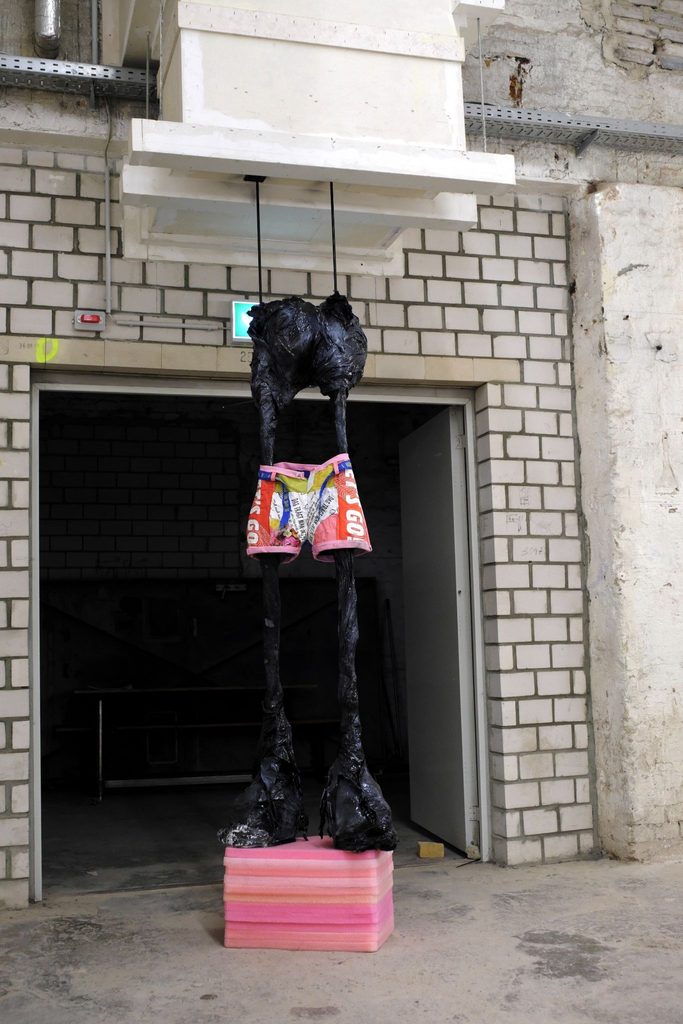
As I enter GLUE, I descend a long staircase into darkness that engulfs me—please turn off the light when you leave. Unaccustomed to it, I flinch at the sound of birds singing near my left ear. This is the work “short stroll” by artist Enrico Leppla. A site-specific porcelain replica of an air freshener, hanging on the wall, deafens passersby every time with a recording of birdsong from the surrounding Berlin parks. I feel my way forward—the light in the main room must be turned on with the utmost care, stepping around long and, most importantly, skinny legs like Ariana Grande’s in her post-Wicked period. The light comes on, and the legs take on the tar-like sheen of melted trash bags. On the trash-bag legs are trash-bag shorts sewn from shopping bags. Sina Robering reimagines the advertising slogans of LIDL and ALDI, placing them just below the plastic buttocks.
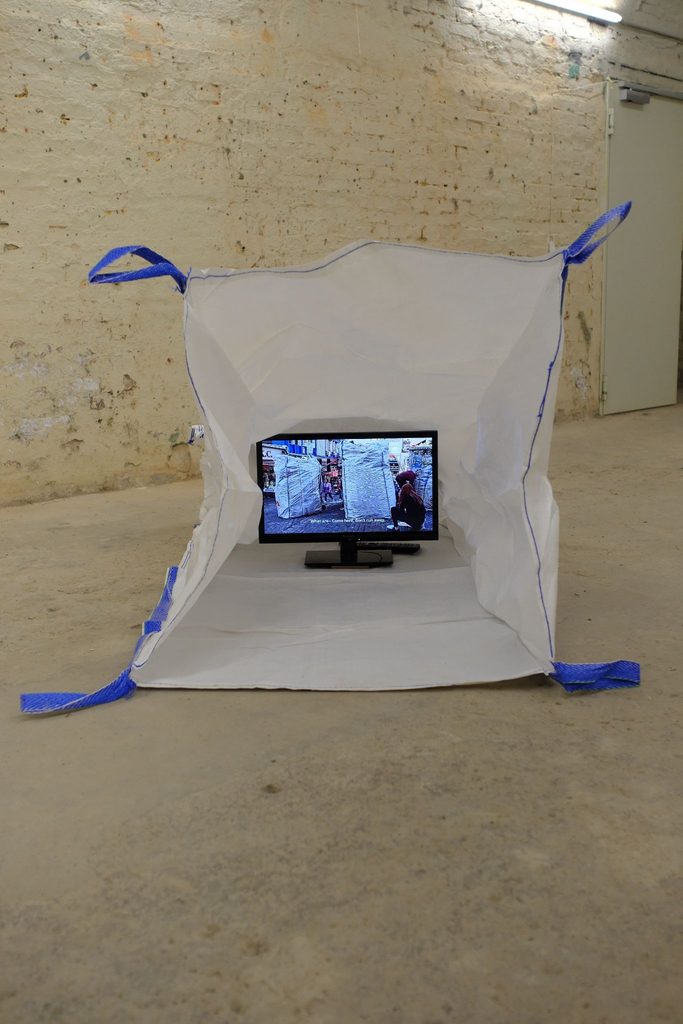
After turning on the lights and checking the space for uninvited guests, I begin to plug in the monitors. The first one is in a large plastic bag: it’s exactly this kind of bag that Zeynep Zülal Bodur paints with two refugee boys from Afghanistan on the bustling streets of Istanbul. It’s in bags just like these that the boys spend twelve hours a day collecting and sorting trash to earn a living.
On my way to the second monitor, I walk past the remaining works. Left-wing spaces for left-wing exhibitions. ALL WILL BE WELL—Postnatural Stories—is the first exhibition by the art duo pksuess, consisting of Austrian artist Lilith Ona and Colombian artist Carolina Díaz. All the works on display are connected in one way or another to the ideas of Timothy Morton—an anarchist, Buddhist, and creator of the philosophical theory “Dark Ecology.” In their exhibition concept, the curators explain that the works they’ve selected reflect on nature not as something in opposition to humanity and progress, but as an inseparable part of it.
Carolina and Lilith, representing the curatorial team of All Will Be Well
Lilith is a student at the University of Linz; this year she came to the Bauhaus through the Erasmus program. Starting in October, she will study stage design at the University of Applied Arts Vienna. She mainly enjoys working in the fields of performance and contemporary theater. She designs costumes and weaves.
Carolina is studying Public Arts and New Artistic Strategies at the Bauhaus; she graduated from the Francisco José de Caldas District University in Bogotá with a degree in Visual Arts. She is a video artist and also works with installations.
How did you come to the idea of forming an art duo?
Lilith
There was no idea to form an art duo at the beginning; it happened while we worked together. I had the idea of doing an exhibition with people from Linz and people from Weimar, because I wanted to remember the time of my Erasmus exchange.
And then Caro was presenting her work in the Künstlersoziale Klasse [class of Art & Social Terrain by Stef Heidhues], and I found it super interesting and it gave me different perspectives on what I was working on.
Caro
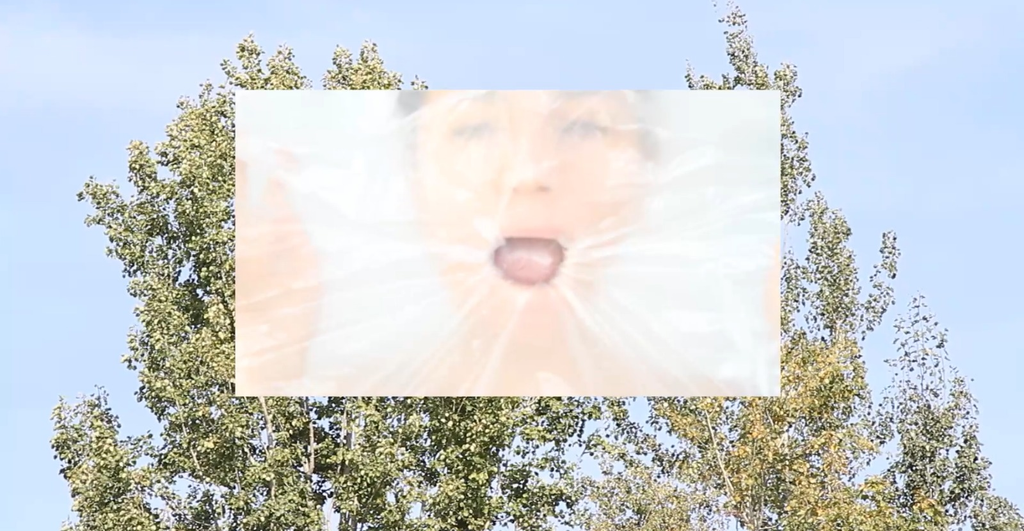
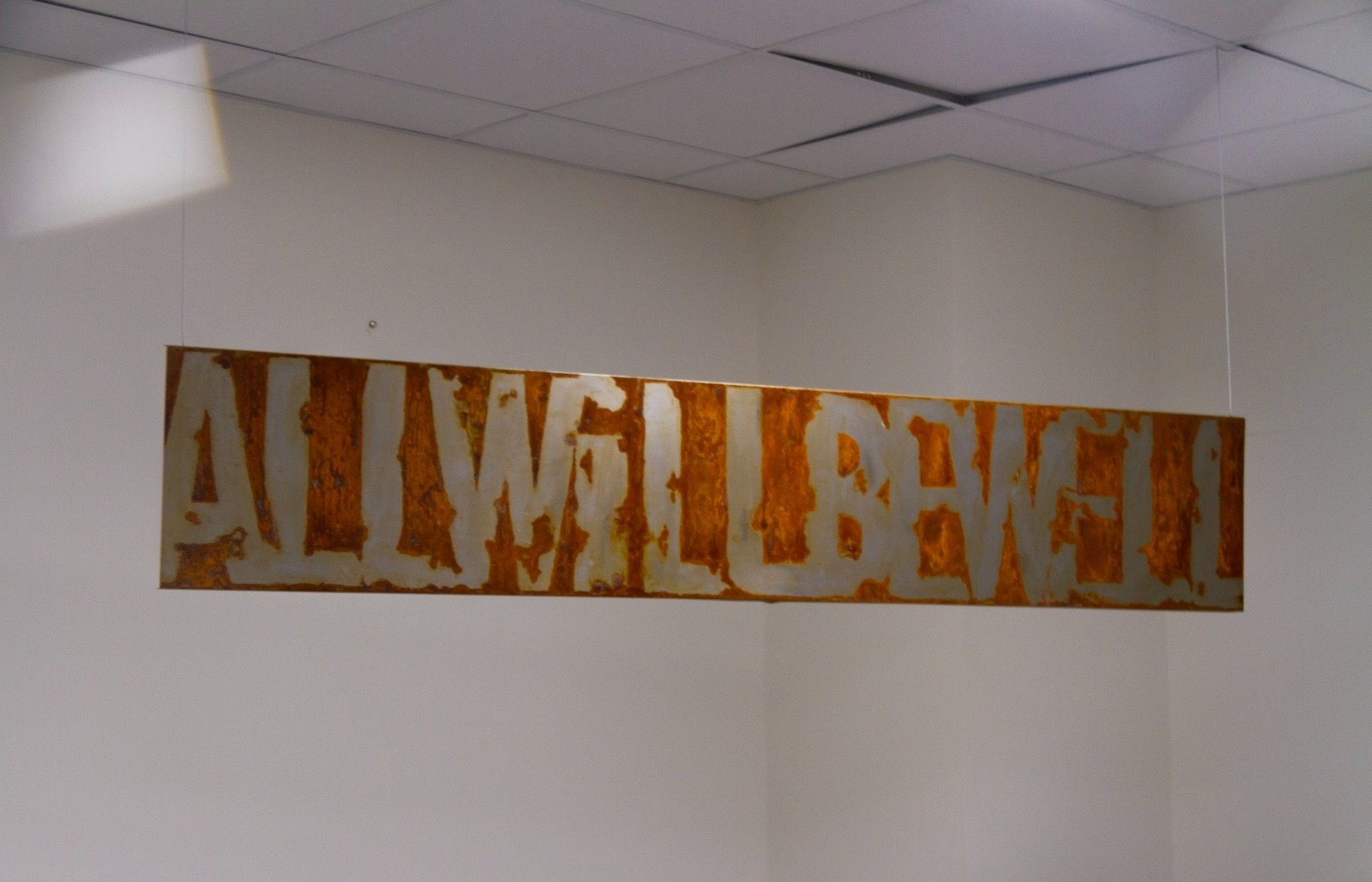
I think I showed a piece of sheet steel with rusty letters, and it was called All will be well. Besides, a video was made. It was about oxidation, how we are oxidizing ourselves while we are breathing. We are basically dying now, while we are breathing.
What is your idea of the apocalypse and postnaturalism?
Lilith
What I find interesting about post-naturalism is that it’s happening now. If you start realising the shades of post-nature and apocalypse in your daily life, it makes it something you can think about more. You think that things are like this, because they developed this way, but it’s because of humans, and nature always has to find a way around us. It’s a one-sided relationship, kind of.
Caro
And I think, I don’t know if I’m more positive about humanity or whatever, but definitely there are some possible futures. And we found that in the exhibition, there are different approaches, so almost 24 people are thinking about the same topic, and finding new ideas of what post-naturality is, meaning what comes after.
What did you discover about each other while working together?
Caro
Lilith is a really positive person. Not just about the concept, but in life. It happened also in the exhibition; she’s always saying: “We can manage to do it.” Before I was thinking that everything is gonna collapse at some point. But now, I think we nailed it. What I found interesting about the whole exhibition process is that it was not about showing this topic, but also kind of experiencing it together, getting to know different aspects of it.
I have more experience simply because I’m older than Lilith, so I was more hesitant and doubtful about how we could make the exhibition possible without financial support from any institution. But in the end, everything worked out. We made connections with other people and received support from Johannes Schweiger, a professor in textile kunst design at Linz University, and Katharina Wendler, the curator of Nova Space, the gallery of Bauhaus-Universität, as well as from the artists themselves. I also think that part of the success came from trusting each other.
Lilith
Caro is also really positive when it comes to working. She is really focused and locked in, and makes things happen. We had a really good exchange between us.
Is there any mythology or cultural tradition that you personally connect with the idea of the apocalypse?
Caro
I think, actually, no. Colombia is a Catholic country, mainly because of Spanish colonisation, so Catholicism also brought ideas about the apocalypse, the end of the world, and salvation. But at the same time, Colombia has many Indigenous communities with very different beliefs and a different way of seeing nature. For many of them, nature is sacred, almost like God. They don’t see themselves as separate from nature; they are part of it, because it is their home. They also have their own stories and mythology connected to nature and its different elements.
So I think Colombia is shaped by these two very different ways of seeing the world. And then there is also the history of conflict. Colombia has been a place of internal conflict and violence for many decades, and the land has always been caught in the middle of that. Maybe because of all this, there is also this feeling that things can change or fall apart at any moment.
I think it’s quite common for Colombians to feel that at some point everything could change. Maybe there is also a difference in how we think about the future, depending on our context. In many European countries, there is more economic and social stability, which makes it easier to plan for the future. Even though Colombia is an incredible place and the second most biodiverse country in the world, it is also one of the most unequal, which creates much more uncertainty. So, in a way, you learn to live more in the present than in the future. I don’t mean that all Colombians or Europeans think this way, but I think the reality we grow up in shapes how we relate to time and the future. Lately, though, I’ve been feeling that the world in general is becoming a harsher place.
Just the other week I was in the Altai region in Russia, and they also have a completely different connection to nature, because some people are practicing shamanism there. For them, every river and mountain has its own character and spirit, and can be understood as a spiritual being.
Caro
That’s quite beautiful, actually, because I was also interested in if this kind of approach exists in other parts of the world, and not just in communities of Latin America.
Lilith
In my research I was also asking myself where this human superiority comes from, especially in Europe, that people think they are beyond nature. I mean, it’s everywhere in the world, but I was especially looking at Europe. And there, I found it also: in Greek mythology, almost every natural phenomenon is explained through a god or a human. For me it’s also really post-natural.
Why was textile such an important medium for you in this exhibition?
Lilith
Well, first we have to speak about textile waste. Recycling becomes important, and a lot of works in the exhibition are done with recycled materials. Then also we had one work from the collective “Štih iz leve / von links”. Their approach is to free traditional textile embroideries from right-wing ideology, to be able to appropriate this textile craftsmanship and to integrate (“female”) handicraft in the art scene. They are an anti-fascist collective, which also is really important, if we speak about nature, because fascism and also for example capitalism are some of the biggest reasons why we have those postnatural hybrids. The goal of this exhibition was never to think about how to restore this loss of balance, because this is not something we can do, but to think about how to live in a changed world and how to critically inhabit space.
The concept for the exhibition was informed by the societal and political ecofeminist movement, which is seeing racism, poverty, sexism, and harm to nature as linked problems, since in this patriarchal society the same harmful mindset is used to dominate FLINTA+ persons, marginalised groups and the Earth. The philosophy of this movement encourages us to choose a nurturing and collaborative relationship with the earth.

How did you work with space? Was it difficult to work with a non-white-cube environment?
Lilith
I mean it was difficult for sure, but not because it isn’t a white cube but because it was a lot of space and very little time. The owner, DAG, showed us the place once and then we went again to another exhibition opening there. Working with this amount of space is difficult, and it would be easier if we had a week there or something, because we organised it without seeing the works in space. And seeing them in space makes everything different again. So we had to be flexible.
Caro
When we saw the space for the first time, there was an exhibition of paintings, and it looked so small! And then when we arrived, and the works were on the spot, everything changed. We were like, oh my god, we have a lot of space. Of course, we were aware that we had a lot of works and the logistics were always difficult, also with electricity and stuff. Working in a white cube is easier in this sense because you have the measurements and you can go and try things out. I think we changed the floor plan at least three times.
Why did you choose this space especially for the exhibition?
Lilith
We met DAG through a recommendation from our professor, Stef Heidhues. The place was accessible, and the owners were super nice and made this possible for us. Of course you pay rent, but for this huge space, it’s not a lot, and they are very kind. And then it was great to have this space, because it also fits the topic. Lucky accident!
Are you a more curatorial or artistic duo? What are your further plans?
Caro
I think we are everything. Different things can happen and we are for sure also interested in working artistically. I think having an interest in common and working together is important, but the other part is just having a feeling, like we work well together. And it can end up being a curatorial duo, but it can also be making art, or cooking!
Lilith
Exactly! Different aspects of life!
We have many ideas; we are applying for funding, but we have to wait. Recently we also talked about what is happening right now, where nature becomes a legal entity. This is an interesting development right now in the whole discourse, because it’s like aiming to give nature the right not to be violated.
This has already happened with a river, because it was so polluted that it got a legal personality, so it could be defended in court. It happened in Colombia, New Zealand and Italy. And they are debating doing the same to the glacier in Austria. Because they are melting so badly, as we have 40 degrees for two weeks.
Caro
Now we are working also and applying for funding, because as you know, we did the exhibition, our first project, without funding support from any external institution. We are really proud of it, but, of course, it’s harsh to work with your own budget.
Many Ways to Eat a Pomegranate
An hour before my performance—the exhibition opening. I’m hiding from my friends and enthusiastic visitors on a bench near the basement. With my face marked by purple bruises, I startle the occasional passerby. I’m not allowed to reveal my stage persona, and my backstage area is the street, still bathed in bright spring sunlight.
Five minutes before the start, I strip down to my underwear and a tank top. It’s very cold in the basement, and I’m shivering. Sweeping the dirty bunker floor with my white socks, I sit down on a black satin sheet. With my back to the entrance, I sense footsteps approaching.
Ten minutes before the end, I undergo changes that seem planned yet feel sudden. My character consumes me, forcing me to bite into a dry, bloody pomegranate and scan the hostile, judgmental audience with my eyes. I search for familiar faces and fail to recognize them. I eat the pomegranate, cutting it open with a knife. I crumple the sheet with my white socks and stain it with the now-ubiquitous dirt. I spit out pomegranate seeds and feel the juice running down my legs, while sticky grains of sand crawl over my bare arms. I don’t have the strength to endure this hostility. I don’t have the strength to protect the pomegranate from the thousands of faces turned toward me. I calm down. I pick out the seeds with tweezers and eat them, already looking sheepishly at the hundreds of eyes staring back at me.
I cut open a second pomegranate, stand up, and offer her a pomegranate seed. She looks at me in fear in response. I eat the pomegranate seed instead of her. I walk over to him. He tries to figure it out, takes the pomegranate seed from my hand, and eats it. This goes on a thousand times. And in a hundred of them, I eat the pomegranate seed, while they eat nine hundred.
A second before it’s over, the alarm goes off. I stop. The pomegranate is empty. I’m trembling and feel my buttocks clenched. I feel like I’m about to burst into tears. My poem is recited in that familiar synthesized voice:
“the apocalypse will be
the colour of sunset
of pomegranate
eternally beautiful
eternally haunted
on the knife’s edge, running
from puberty
from the democrats
to the loving embrace
of proletariats
the apocalypse will be
in the soul of cyberpunk,
or maybe noir,
it’s not that important, in general
the point is to miss something again
miss the past, again
here we go again
our nostalgia will kill us
loving and patient
we will think of God
our hope for salvation
still alive
still dancing
not yet still
on Vokzalnaia street
under a jacket
and when the world reaches
its final sunset
we won’t notice
we will be grateful
we will be grateful
for the glimpses and glimmers
grateful for
the bright
hot sun”

Recommendations from Lilith and Caro
- Porta
Independent cultural house, São Paulo
- Im_Flieger Vienna
Free Space and Experimental Ground for Dance, Performance Transmedial Art
- Javaneh Verein
Literature, Movies
- Astrida Neimanis, Hydrofeminism: Or, On Becoming a Body of Water. Laboratory for Aesthetics and Ecology, 2018.
- Dancing Bodies, Dancing Gender, Dance in the 20th Century from a gender-studies perspective, 1999
- Christopher D. Stone, Should Trees Have Standing? – the foundational essay arguing that natural entities should have legal standing, 1972.
- Marisol de la Cadena, Earth Beings: Ecologies of Practice Across Andean Worlds, 2015
- Avatar: The Last Airbender, 2005–2008.
- Doreen Massey, “Landscape as a Provocation: Reflections on Moving Mountains,” Journal of Material Culture, vol. 11, nos. 1–2, 2006, pp. 33–48.
*“DAAD’s activities have been designated undesirable in Russia.”